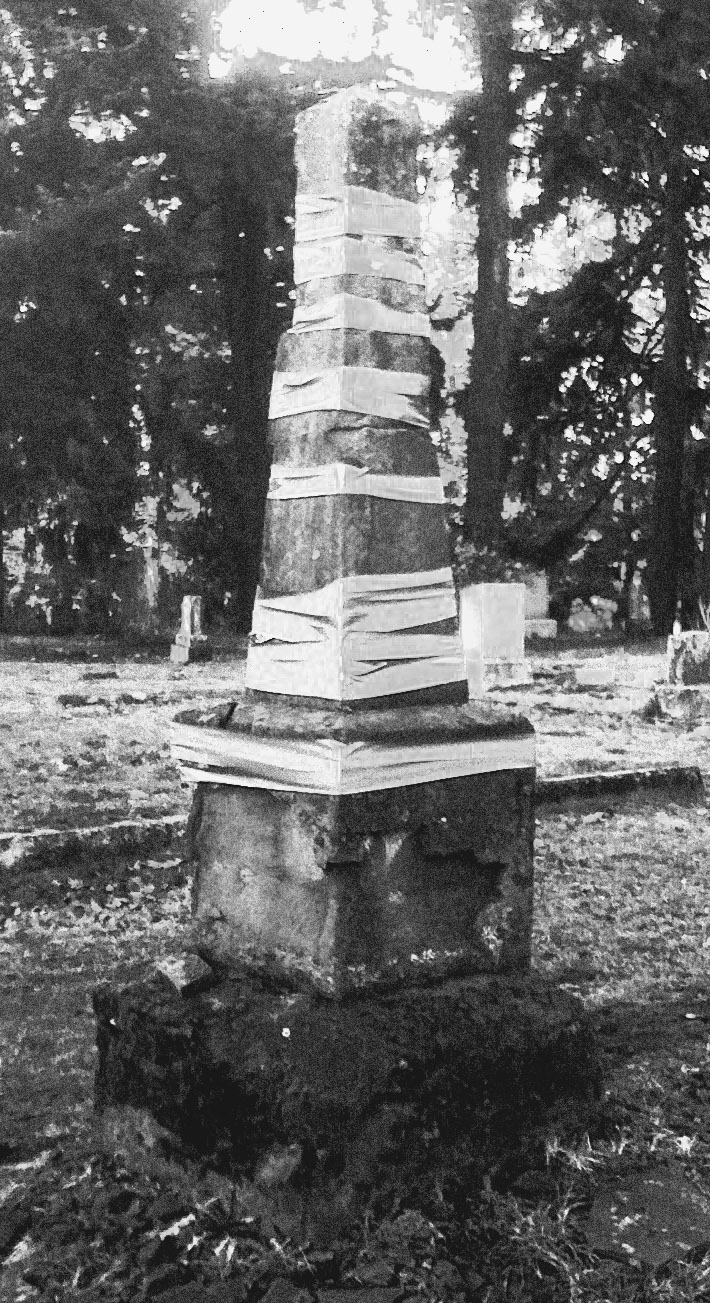
 Passing through the cemetery on a late December afternoon, we see a sort of silver specter in the distance ahead. A ghost would not be out of place here where old settlers of Oregon’s upper Willamette Valley rest for eternity. But this is stranger than a ghost. Less believable. And so we move closer, thinking with each step, It can’t be. It really can’t be.
Duct tape. And this was a case of repair, not vandalism. The gravestone was split almost completely through in a few places and in a general process of disassembly. When all else fails, you can hold your family history together with duct tape.
A more standard method of preservation is reliance on memory, which we call oral history when it happens to other people. Memory is augmented by a handful of puzzling photos of people we know we should be able to identify. We look into stern eyes and rustic homes and feel a sense of pride. But also a quiet concern that we might be proud of the wrong person. Perhaps a cousin or a family friend. If you played Simon in the early 80s, or have walked into a room and wondered why you were there, or have visited an elderly parent who no longer recognized her own child, you know that the only reliable thing about memory is that it is pretty dodgy.
Go back about 150 years, and you’ll find a sturdy Norwegian fisherman stepping onto a larger boat than he is used to, leaving behind the fjord and snow-smothered fields of his youth to jounce across the Atlantic for a new country and, with luck, a new life. Risk, worry, hope, eased by the occasional sour indulgence in lutefisk and the company of his diaspora. It is a nice story if you don’t mention the wife and children left behind.
Now in South Dakota, the settler finds a new wife, Mary, and with her has children whom he names after those he has abandoned in the old country. This gives him two sons named Thor–one on each side of the Atlantic. But his second wife and his second Thor die. So he finds a third wife, with whom he can extend the family, adding a daughter named Mary (after the second wife) and a new son. The third Thor. That is how my ancestor brought the family name to America. This is the story as I remember it being told to me, and there is a reasonable chance that some part of it might even be true. But it is my memory of someone else’s memory of, most likely, someone else’s memory.
A better method of preserving family history is to write it down. That’s why I know so much more about one of my distant ancestors, William Bradford, even though he came to America 250 years before the Norwegian fisherman. Bradford the Pilgrim, holding onto a new home against the toughest odds, recorded in his now-famous diary accounts of starvation and disease, hurricane and earthquake, diplomacy and law (including a strange case that resulted in the execution of both sheep and shepherd).
But equally important stories from more recent generations are slipping away. Half-remembered rumors, conjectures, delusions. The aunt who swears she was orphaned off in her youth while her siblings insist, No, you weren’t. The uncle who mumbled obscenities through evening prayers and went quietly insane. The sister who committed suicide and was rumored to be pregnant. We bury our scandals and defeats as if their past existence could somehow weaken the family line. A history made up not so much of family, but of a name that stands for a family.
Three thousand miles east of the duct-taped Oregon grave, Boston’s famous Granary Burying Ground holds twice as many skeletons as gravestones. Immigrants and patriots began to occupy the cemetery back in the mid 1600s, lying under fantastic slate stones etched with flying skulls and images of Death dancing with Afterlife. But caretakers in later generations were not satisfied. The plots were strewn about randomly. Hard to maintain and not pleasing to later aesthetic sentiments. So the crooked dead were left in their now forgotten spaces while the stones above them were moved and arranged into neat, straight rows.
The dead are inconvenient. Their stories as crooked as the original plots at the Granary. But if past lives don’t align with how we want to see ourselves, they are still an essential part of our history. What we account for as success, after all, is transient. The homes our ancestors built are mostly gone. Farms fallowed and businesses bust. But their struggle is timeless. The struggle for money and shelter, the struggle for meaning and moments of joy, the struggle to set the next generation on its feet. This is our legacy and it is worth preserving. Even if awkward. Even with duct tape.
 Searching for Yoldash