Sometimes while mountaineering in the Pacific Northwest, you’ll fight hours of underbrush, punch through half-frozen rivers, and slip your way up maddening scree under sleet and fog. And just when you are the most lost, the most exhausted, you emerge from the clouds and stumble upon other climbers. They are lost too. They are tired. And they are cursing Becky.
 That would be Fred Becky. The man who almost single-handedly defined climbing in the Northwest, who made more first ascents than anyone in recorded history, who will scale a cliff with thousands of feet of exposure more easily than most of us can cross the living room.
When climbers talk about a “Becky Route,” they often mean the hypothetical route which is documented in climbing guides, but seems not to be possible. When they talk about “Becky Time,” they are referring to the mythical Becky pace that will take you from trailhead to summit to bar in one day. You complain about this pace in the late afternoon when you are still trying to reach the summit, and the nearest bar seems continents away.
Like most legends, Fred Becky has his fair share of detractors and acolytes, but he is still a legend. So when we heard he would be speaking at Edgeworks Climbing in Tacoma, we were in.
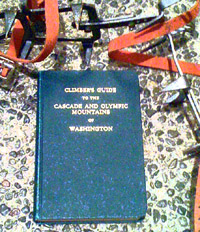
For autographing, I brought along his groundbreaking guidebook from 1949, which the Mountaineers had refused to publish. Long before I was born, my uncle kept notes in this very book as he trained to climb Mount Rainier in 1951-52. By the time I climbed the same peaks, half a century later, avalanches and rockfall had transformed the physical landscape. But the Becky routes remained in print, viable or not.
So I made the pilgrimage to Edgeworks to see Becky’s photographs and hear his wisdom. As it turns out, Becky isn’t so much interested in wisdom. If you invite him to speak at your climbing gym, he’ll tell everyone there to get out of the gym and climb in the “real world.” He will show you peaks from Alaska to Mexico, with photos from climbs in 2008 alongside climbs in 1956. But he will not comment on the out-of-date equipment you see, or the age of the young spry Becky in many of the photos. He is really only interested in the ageless peaks themselves, and the challenge they represent.
After the presentation, I brought him my uncle’s old book to autograph. A book so old it says nailed boots are basic equipment for every climb. But also a book that opens with a statement just as true today as 60 years ago: “Since climbing in Washington is seldom done with guides, self reliance, keen judgment, and the technical competence to climb on steep alpine terrain are prerequisites.”
I presented this old, first edition book from Becky’s youth to him for an autograph. He seemed not to recognize it. And then a 20-year-old behind me pushed forward and said, “You had a John Muir quote at the beginning of your presentation. Can you tell me how Muir inspired you?” And the 86-year-old climbing legend paused and looked tired for the first time in his life. “I never thought about it,” he said.
 Searching for Yoldash