Feeds:
Posts
Comments

Forrest shows off

When Peter P. joined the Windows 7 team as a user experience designer, he was given an opportunity most designers can only dream about. There are more than 1 billion PCs in use today, over 90% of them running Windows. If you are looking to change the way people interact with the products in their lives, this is heady stuff.

Just don’t let it go to your head.

There are so many places in Windows 7 for a UX designer to make an impact, from the touchscreen experience to the new ribbons in Paint. But as Peter explained to me at a recent tweetup, users have made one thing very clear: Don’t mess with Notepad.

Turns out, people value the lowly text editing program not for its features, but for its lack of features. The top use of Notepad, especially among developers, is to strip out formatting. The last thing a Notepad user wants to see  is change in the name of improvement.

This is not simply a case of leaving well enough alone. When we watch how people really use products before determining the next feature set and put aside preconceived notions of how a product is supposed to be used, we develop better products. The same principle that has preserved the simplicity of Notepad for nearly 25 years led to significant enhancements to Excel early on when it was discovered that people used their number crunching software to organize text. This is why the very word processing features that have been kept out of Notepad all these years have been added, release after release, to Excel. 

If we look around us with an eye to how products are “misused” today, we can get a sense of where things are going. My son Nick doesn’t have an iPod, so he downloads music onto his digital camera. Considering the storage capacity of his camera, and the mediocre quality of the camera on my iPhone, I think he may be onto something.

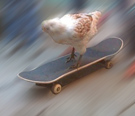
Two weeks ago, our verrückten German friends took care of the chickens while we were away in Montana for Thanksgiving. Before long we got a link to a Facebook page with a picture of Forrest riding a skateboard. I’m pretty sure a pair of 8-year-old girls put Forrest up to it, but it is pretty interesting.  I’m not saying that chickens are the next big thing in children’s entertainment, or that sports are the next big thing in chicken entertainment. But just in case, I’m keeping a lookout for skateboarding chickens.

Montana Standoff

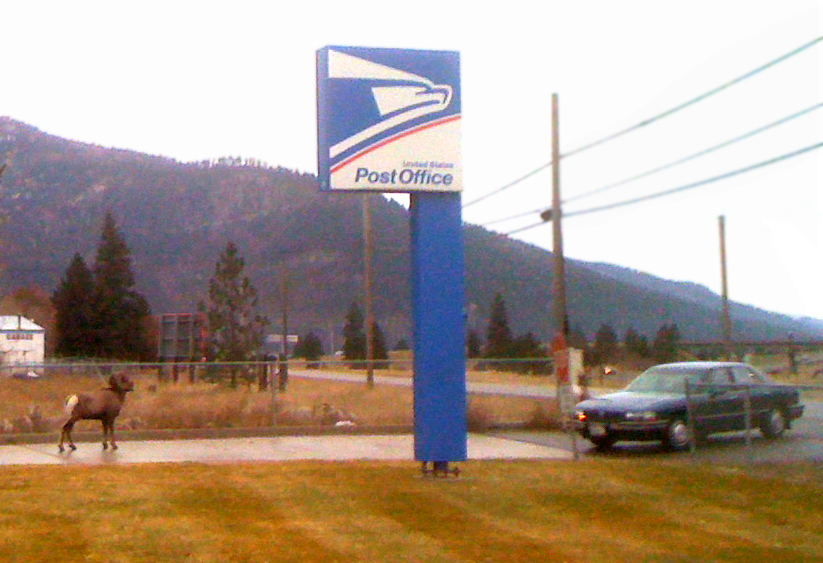
How’s this for frontier life? Just east of Missoula on Sunday, we saw 22 bighorn sheep blocking the entrance to a post office. There were other out-of-staters like me stopping to gawk, but then a woman from Montana drove up and nudged her car forward until 21 of them had scattered and one lone ram remained. The rest of us watched, holding camera phones in the air from a distance, as the woman drove around the ram, mailed her letter, and then drove back around him and headed straight off to her next errand. And I thought, is it more quintessential Montana to see 22 bighorn sheep standing around the post office, or to see a woman who treats them as a mundane nuisance?

Kindling

Don't try this with KindleMany people suffer from the misconception that books are just an old fashioned way to share ideas, knowledge, and experience. Books are good for that sort of thing, yes, but before you ditch them for a shiny new Kindle, remember that there are functions printed books perform for us that a Kindle simply cannot duplicate. Consider three of the most important ways a book can be used:

  • To Show Off
  • To Fend Off
  • To Piss Off

A Kindle doesn’t show people how smart you really are.
Imagine what it would be like to have offices without bookshelves radiating intelligence and expertise. A lawyer without law books, an editor without a fat orange Chicago Manual of Style, a marketer without something by Seth Godin. How would you know these people were not rank amateurs? I recently worked with a group of marketers who were keenly interested in taking advantage of Twitter, but they couldn’t be bothered to set up Twitter accounts and talk to actual people. So instead, they obtained free copies of Joel Comm’s book Twitter Power and displayed them on their office shelves like diplomas. That way, people visiting their offices saw the book and assumed they were experts in social media. Brilliant!

It’s hard to fend off strangers with your Kindle.
Surely protection is one of the most important, if unappreciated, functions that books perform for us. When you put a book cover between your face and the people around you, you are showing them why it is better not to disturb you. A good friend of mine brought the following book to his daughter’s soccer practices this year: Richard H. Timberlake’s Monetary Policy in the United States: An Intellectual and Institutional History. The title alone told the other parents that he was morose, aloof, and not even remotely interested in discussing the latest scandal about bikini-clad baristas. I used a similar tactic when I rode the Tube every day as a student back in 1989, in this case wielding Daniel Defoe’s A Journal of the Plague Year. This book was doubly effective at keeping strangers away by telling them I was dull and pedantic while reminding them that every breath from every other subway rider could spread disease.

You can’t offend people by destroying your Kindle.
The most grievous of sacrileges in Western Civilization, next to banning books, is burning them. Fahrenheit 451 horrifies us because we equate the burning of books with the annihilation of ideas. If you disagree with an author, nobody cares. But burning a book, now that will get you some attention. The trouble with Kindle is, if the content angers you, you just delete it. If you want to destroy your Kindle, you have to recycle it because it won’t burn. And then instead of offending others, you just look like a good earth-friendly citizen.

Oh yes, and there is one more important way a printed book is superior to any electronic format. Most of us first learned to love books by tearing them apart. I’m talking, of course, about the pop-up book. Long before we learned how to read text, we learned that books sometimes contained pictures that would unfold magically before our eyes when we tugged at the pages. The harder we pulled, the faster the picture jumped up. Until we pulled too hard. And that was when we began to learn about how to be respectful of books and the ideas they contained. You could tug at them a little, fold the corners over if you didn’t have a bookmark handy, maybe write a few notes in the margins. But you were not to tear them, or throw them, or burn them except under extreme circumstances (say, for a blog photo).  You might take care of a Kindle because it is expensive to replace, but not because of the ideas it stands for. After all, the Kindle is as much about deleting old ideas as conveying new ones, so in the end the only idea it really stands for is convenience. And no school or library or despotic little country ever found convenience unsettling enough to ban.

That’s why I’m sticking to books where solid ideas are permanently inked onto fragile paper. Books I can use to keep strangers from talking to me. Books I can use to say, “My Dostoyevsky is smarter than your Dan Brown.” And if a funny picture unfolds when I open the pages or pull a secret lever, so much the better.

Seldom With Guides

Sometimes while mountaineering in the Pacific Northwest, you’ll fight hours of  underbrush, punch through half-frozen rivers, and slip your way up maddening scree under sleet and fog. And just when you are the most lost, the most exhausted, you emerge from the clouds and stumble upon other climbers. They are lost too. They are tired. And they are cursing Becky.

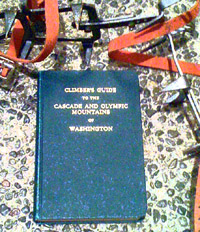
Becky guide from 1949, with cramponsThat would be Fred Becky. The man who almost single-handedly defined climbing in the Northwest, who made more first ascents than anyone in recorded history, who will scale a cliff with thousands of feet of exposure more easily than most of us can cross the living room.


When climbers talk about a “Becky Route,” they often mean the hypothetical route which is documented in climbing guides, but seems not to be possible. When they talk about “Becky Time,” they are referring to the mythical  Becky pace that will take you from trailhead to summit to bar in one day. You complain about this pace in the late afternoon when you are still trying to reach the summit, and the nearest bar seems continents away.

Like most legends, Fred Becky has his fair share of detractors and acolytes, but he is still a legend. So when we heard he would be speaking at Edgeworks Climbing in Tacoma, we were in.

For autographing, I brought along his groundbreaking guidebook from 1949, which the Mountaineers had refused to publish. Long before I was born, my uncle kept notes in this very book as he trained to climb Mount Rainier in 1951-52. By the time I climbed the same peaks, half a century later, avalanches and rockfall had transformed the physical landscape. But the Becky routes remained in print, viable or not.

So I made the pilgrimage to Edgeworks to see Becky’s photographs and hear his wisdom. As it turns out, Becky isn’t so much interested in wisdom. If you invite him to speak at your climbing gym, he’ll tell everyone there to get out of the gym and climb in the “real world.” He will show you peaks from Alaska to Mexico, with photos from climbs in 2008 alongside climbs in 1956. But he will  not comment on the out-of-date equipment you see, or the age of the young spry Becky in many of the photos. He is really only interested in the ageless peaks themselves, and the challenge they represent.

After the presentation, I brought him my uncle’s old book to autograph. A book so old it says nailed boots are basic equipment for every climb. But also a book that opens with a statement just as true today as 60 years ago: “Since climbing in Washington is seldom done with guides, self reliance, keen judgment, and the technical competence to climb on steep alpine terrain are  prerequisites.”

I presented this old, first edition book from Becky’s youth to him for an autograph. He seemed not to recognize it. And then a 20-year-old behind me pushed forward and said, “You had a John Muir quote at the beginning of your presentation. Can you tell me how Muir inspired you?” And the 86-year-old climbing legend paused and looked tired for the first time in his life. “I never thought about  it,” he said.

He Liked to Open Cans

Somebody at Dictionary.com goofed up this week, and it was wonderful. Tuesday’s word of the week was sommelier, which of course is a person who knows how to match the right Malbec with your roast lamb. The correct definition for sommelier was posted online (check 1), and also sent out through Twitter (check 2). But Dictionary.com’s original email notification contained not only the wrong definition, but mixed up the quotations illustrating usage as well (uh oh). To be fair, they caught most of the mistakes and sent out a corrected email later, but the damage was already done. I could not shake this misquotation from my mind:

misquote

When you read the above misquote, three things jump to mind immediately. First, Hemingway will have a hard time going online to check a menu if he dies in Ketchum, Idaho in 1961, long before the advent of Netscape and the first PC. Second, Hemingway is spelled with only one m. And third, he never wrote like this. Never ever.

And it is this last point that is most interesting to me. As soon as I read the misquote on Tuesday, I started thinking about what it would be like if Hemingway and other writers we hold dear had lived in the age of Facebook and Ning and Twitterific. Would they have a Twitter profile?  Henry James and Virginia Woolf, for example, could not condense the striking of a match into a single sentence, much less 140 characters. Hemingway at least is famous for short, simple sentences, such as, “He liked to open cans.” And you could tweet that easily enough. But out of context, it is essentially meaningless, like a keystone which by itself is a crooked rock lying on the ground, but supported stone by stone from each side is capable of supporting the entrance to a whole cathedral.

Social media applications are great for building connections with other people, but not so great for sharing unfamiliar ideas, especially complicated ideas that cannot be grasped in 60 seconds of video or 140 characters. Some things just require more time, more development, more contemplation. You’ll find a lot of funny jokes and recycled wit in social media. You’ll meet people from around the world who will help you when you least expect it.  But you won’t find many Charles Ives ringtones.

Mind Your StepHonesty is not a policy. Transparency is not a communication strategy. But you’d hardly know this from the number of so-called “community features” appearing across company websites today—all in the spirit of an open and transparent approach that we’re told is so critical to survival in the Web 2.0 world. While it’s true that frank communication is important for credibility, smart companies have the right conversations in the right places.  A forum that publishes unfiltered comments should also include responses from real people in the company, creating a dialog between those who care enough about a product to share their opinions in public. Simply giving customers extra places to complain without monitoring and responding will more likely damage a company’s credibility than improve it.

Take Epson, for example. If you are looking for a new printer and considering Epson, it’s natural enough to go to the company’s website for details on available products. You would expect to find prices and feature lists. But Epson.com also includes customer ratings and comments on their site for each printer. You can actually learn a lot from customer reviews on Epson’s site. For example, you can learn that one printer is so loud it makes the ower jump, and another “makes little circles, like a slinky, in your photos.” Good information for prospective buyers, but not good for Epson.

A better integration of community features can be found on the D’addario company website, where team blogs connect employees with customers. An artist relations manager shares his bouzouki stringing nightmare. A regional sales manager dives into myths about saxophone reeds. These posts demonstrate that D’addario employees are interesting people with passion and expertise to share. If it seems unfair to compare ink jet printers to bouzouki strings, consider how interesting GEICO and Progressive have made the insurance industry. Progressive maintains a Facebook site dedicated to people who want to dress up as Flo, their quirky spokeswoman, for Halloween (check out the fan photos). Even the Washington State Department of Transportation maintains a funny and engaging community presence with an active blog and Twitter account.

The point is, successful Web 2.0 implementations nurture the relationship between a company and its customers. They demonstrate that people in a company are willing to contribute to this relationship by solving problems, recognizing loyal customers, and simply being personable. Ultimately, being earnest in the relationship goes a long way toward building loyalty, and is more important than simply being accurate about issues and challenges. You can be frank without  committing to positive change. But when you are earnest, you are committed.

Oh, and honesty? That’s just personal integrity, plain and simple. Something that seems to be missing from the Epson site, where someone from the company has seeded the customer comments with entries like this: “I found this printer to have exceptional print quality, easy installation and really like the Instant-dry DURABrite® Ultra Ink.”

Meet Forrest

Used to be you could identify the nutcases in your neighborhood by their gangly ham radio antenna towers and gardens with too much zucchini. These people lived within a system of ever-evolving technology, efficiency, and comfort. But they weren’t quite comfortable. With every step forward in evolution, they were haunted by a sense that something important was being left behind. They wanted more control of the things they consumed, whether it was food, information, or entertainment. Today you won’t see the ham radio towers in your neighborhood, but there are other signs. Cars with biodiesel bumper stickers. Kids almost floating off in UFO-shaped balloons. Chickens walking casually around the yard as if they were tabby cats. 

forrest

Forrest

So confession time. We have joined the ranks of crazy suburbanites with chickens.

We have three hens named by my sister who raised them from eggs in Olympia. There is Gladys the Black, Wilbur the Gray, and Forrest the Brown. Forrest was named after a character in a Winston Groom novel who in turn was named after Nathan Bedford Forrest, Confederate general and first Grand Wizard of the Ku Klux Klan, which as most people know is an organization of chickens who run around at night instead of day. Forrest in the novel (and subsequent movie) is a simpleton. Forrest the chicken is a simpleton even by chicken standards. Hence the name.

People today need reassurance about their food. Did my beef come from a happy cow? Did my egg come from a chicken free to walk on actual dirt? Did terrorists sneak into the warehouse during a smoke break to poison my food? When you raise your own chickens, you don’t need to fret over these things because you are in control and know all the details. Today, for example, I know that Wilbur ate nasturtiums, pears, and left-over Cheerios. I know Gladys spent her day under the Japanese maple and the Chevy Suburban hiding from rain. And I know that Forrest followed the other chickens around like a hopeless groupie.

Our hens are only a few months old, so we are still eggless in Seattle.  But I can tell you that there is much more to raising chickens than getting fresh eggs every day or an eventual Kung Pao Gladys. We have raised guinea pigs, gerbils, lizards, newts, dogs, cats, two garter snakes, even an orphaned squirrel. Of them all, chickens are the most entertaining to watch. They combine thousands of years of careful domestication with the most primitive of instincts. And when you watch them, you witness both. Chicken life alternates constantly between complacence and panic. Complacence comes from being around familiar company and not having to think.

Chicken panic has three sources:

  1. Another chicken is getting food that should be  mine.
  2. The neighbor dog/cat/toddler is chasing me.
  3. The other chickens have left me behind.

Cats are warm on your lap, and snakes are fascinating when they lunge at a banana slug as if it were really capable of escape. But for sheer entertainment, nothing beats a chicken.  They do stupid things, which is amusing. They coo when you hold them, which is endearing. And they surprise you with their predictability. For now, I watch them and congratulate myself that one day our eggs will come from a pure, natural source, even if the truth is that our eggs still come from a faraway farm, and our hens are living it up without producing anything to pay the rent.

Not Listening To You

In his later years, British writer Evelyn Waugh carried a Victorian ear trumpet with him which he would raise to his ear while speaking so that he could better hear his own wit. But when others tried to speak to him, he would take it down.

Amazingly, this is the way most businesses today approach social media. In large part, this is because too many marketers treat social media as if it were just another outlet for their newsletter content. They pay close attention to their own communications, scheduling and monitoring posts and tracking click-through rates. But when it comes to listening to what others are saying about their business, they are tuned out.

The need to listen and respond goes well beyond replying to the occasional direct message. Most of what is said about a company—good and bad—is not sent in a direct message. Instead, questions, comments and complaints are usually made openly to the community. If your business maintains an active account within the community, responses are not only acceptable, they are often expected.

And it’s not just about putting out fires. Successful social media marketers contribute to conversations, recognize fans, and learn what matters most to their customers and prospects. While there are a number of good commercial applications for monitoring conversations across blogs and online communities, you don’t have to be a big company with a social media budget to get started. Monitoring the millions of daily posts across Twitter can be as simple as finding the key words that produce the most relevant results for your business on www.search.twitter.com, and then subscribing to the RSS feed for the search query. It’s about as simple as an old ear trumpet, really.

A Night at the Butcher’s

Butcher Shop CafeIt’s not every year you dress up and bring your candles to the butcher shop. But this isn’t like most years. Money is tight. Jobs are scarce. The future is more than just a little hazy. In other words, it’s time to get creative. So rather than go to one of Seattle’s great restaurants on our night out, we opted to go directly to the butcher that supplies the best of them. The Butcher Shop Cafe on Juanita Drive is not exactly your ordinary butcher. You can order everything from kielbasa to guinea fowl and have the chef prepare it right there. This Saturday we had prime rib, which was outstanding. For side dishes we pretty much ate everything available, including baked corn salad, beans with brisket, and sauteed squash and peppers.  The cafe is more utilitarian than pretty, but for some of us, that is much of the appeal. And what you trade off in elegance you gain in more personal ways. It’s a great place to relax with your best friend, chat with the chef while sampling next week’s menu, and indulge in shamelessly generous portions. And if you happen to wonder where exactly the sirloin cut comes from, why there is a diagram right there behind the counter. It is a working butcher shop, after all. And there are only three tables, so if you plan to go there for dinner, it helps to call ahead. The cafe, butcher, and supplier are all available at 425-485-4658.

The Answer is Always Fly

Ultraman Toy Flies“Would you rather breathe under water,” my son began, but I knew where this was going and cut him off. Fly, I said. We were on a boardwalk over Juanita Bay, watching the sunset as a family. “Would you rather,” he started again, but again I interrupted. The answer is always Fly. I tried to explain this as a wise man explains a simple world to a complex child.  But he persisted in the game. Would you rather this? Would you rather that? It was a challenge to him now, but of course nothing compares to Fly.

He is young and clever, so he said, “Would you rather fly if you could not stop and flew to your death?” I am older and still a little clever, so I said, “Fly.  What is life, after all, but a long flight toward death?”

He was quiet for a moment, trying to set up a trap for me. Then he grinned triumphantly: “Would you rather fly or be with Mom?”

My wife looked around to listen for the answer, interested for the first time in this conversation. But I am still a little clever, so I offered, “I would fly into your mother’s arms.”

Sophistry is a perfectly good equation for an incorrect sum. And everyone recognizes this except the marketer, the lawyer, or the man on the boardwalk at sunset. The childish game began to sound like a stark accusation aimed squarely at middle age. Why is Fly always the answer?

But I am still a little clever, so I said: “Would you rather be connected to a Siamese twin who hated you, and sometimes tried to kill you in the night, or fly?”

He picked Fly, and I maintained a narrow lead in the game.