Feeds:
Posts
Comments

The Reaper came to Gladys in the form of a joyful, bouncing Irish terrier. The same terrier who this fall killed Wilbur and left her as a gray, plump, feathered heap in the front yard, while the remaining chickens cowered fearfully under the farthest recesses of the front porch. 
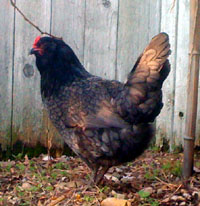
Gladys with Tail

Gladys with her proud tail intact

Yet these chickens who watched Wilbur die forgot their trauma, and were flying out of the safety of the backyard to raid the neighborhood bird feeders within a week. If elephants really never forget, chickens surely never remember. 

Our next door neighbor accused the terrier’s owner of harboring a chicken killer (sort of the opposite of being a son-of-a-bitch). The owner was not amused, and began to glower at us instead of waving as she walked her chicken killer past our house every overcast Northwest afternoon. Certainly we could not blame her. Yes her dog came into our yard seeking game, but we let our chickens into the front yard. Or rather, they let themselves into the front yard by flying over an inadequate gate. 

In strange irony, when we dismantled our rotting deck and its protective gate a month ago, the chickens lost interest in the front yard and the neighborhood beyond. For the first time since Wilbur’s death, they were free to roam, but instead they mostly kept to the space around their henhouse. And I became complacent. 
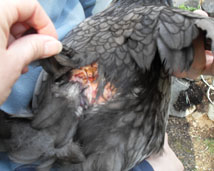
Immediate trauma

Then on Saturday it happened. I was in the woodshed when I heard the commotion. Swans are supposed to release a beautiful song at the point of death, but chickens are no swans. They just squawk bloody murder. 

I leapt from the shed with a caulking gun in one hand, which I threw desperately in the direction of the commotion. But this was too many seconds after the attack to make a difference. I was coming from too far away. 

The terrier had run around to the back of the house, found Gladys and seized her, was killing her in her own water trough. The miracle of her survival came from the survival instincts, as it turned out, of the previous homeowner. He had created a sort of bomb shelter to store up emergency food and water, and our kids had turned this into their own fort. As luck would have it, the fort was located next to the chicken coop, and there were two kids inside when the attack came. So right as the terrier had the chicken submerged in the water trough, an 11-year-old boy burst onto the scene and pulled Gladys from the jaws of death. 
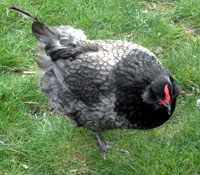
Gladys without her tail

Gladys without her proud tail

I came as fast as I could, passing the misused caulking gun and entering the scene of screaming children and traumatized chickens. In the middle of it all stood a young, beautiful terrier. A chicken killer interrupted in the middle of the most natural of jobs. 

So I scratched him behind the ears when the kids were not looking and opened the nearest gate to send him home. Then I set about repurposing pieces of the old rotten deck to erect a hideous but sturdy gate which would keep the chickens in and the dogs out. Would keep the chickens away from the neighbors’ gardens, and keep their dogs away from our chicken coop. Wilbur in Heaven is clucking in disapproval at the slowness of my actions.  And Gladys is running about the yard without her once proud tail. But she is already looking for a way over the fence to the unprotected front yard and the neighborhood beyond. And she is strutting again. Because chickens, after all, never remember.

O Canada, Who Are You?

O CanadaThis post first appeared on Technorati.com

When a 9th grader asked me to teach him the Canadian national anthem earlier this week, I thought it was a pretty straightforward request, and a quick search online would fill in the blanks. But I was mistaken. Canada has no national anthem.

Most Canadians would dispute this. They made it through a record 14 gold medal ceremonies in the 2010 Winter Olympics, after all, singing the refrain, “O Canada, we stand on guard for thee.”

But what about French Canadians? The English and French lyrics are not aligned. French Canadians don’t stand on guard to protect Canada. Instead, they count on Canada to stand on guard for them–to protect their homes and their rights.  Both sentiments are worthy of a national anthem, but at some point, you have to agree as a nation what it is you stand for. That’s why it is called a national anthem, and not a this-is-what-it-means-to-me improvisation.

French Canadians have remained consistent, singing the same words to the same tune for 130 years. But English-speaking Canadians can’t leave well enough alone. First, they translated the French lyrics but kept the sentiment. Then, they borrowed the tune but gave it completely different lyrics. Then they added extra stanzas. Then removed them. Finally, in 1980, the English lyrics were officially settled, based on an early 20th Century version that focused on the sacrifice of Canada’s sons to protect its borders. Not surprisingly, this version gained popularity during World War I.

Trouble is, these lyrics have nothing to do with the French-language version. And as it turns out, the English version is still controversial. From 1990 up to the present day, both liberal and conservative Canadians have objected to a line in the current English version: “True patriot love in all thy sons command.” Most recently, the ruling conservative party asked the Canadian Parliament to consider reverting the current English line about “sons” to an earlier, pre-WWI version that expressed the same sentiment but in gender-neutral terms. Interestingly, both versions were from the same author, Stanley Weir. No matter, the current opposition party felt that the suggestion was a political maneuver, and not worthy of consideration.

It is time to decide. By 2031, according to Canada’s Globe and Mail,  one in four Canadians will be foreign-born. The need for a unified vision of purpose has surely never been greater, and no single expression of this purpose will be more visible than Canada’s national anthem. If it can pick one.

In the United States, we have struggled with the same pressures from immigration; have been lured by bigotry and protectionism. But from the very beginning, we told a beautiful lie about ourselves and waited for it to come true. We waited more than 200 years and argued incessantly about the best route, but the goal has remained the same.

If it’s a truly national anthem, there can only be one version. It doesn’t need bombs bursting in air, although concrete language definitely helps. The original French Canadian anthem is clear and concrete, and if I were Canadian I would sing the French version. I would sing it badly and mispronounce the words, but I would get the sentiment right, and I would sing it proudly. After all, the composer, Calixa Lavallée, was a Canadian who fought in the American Civil War and died in Boston. We share a vision of unity through diversity, of strength through independence. And we are willing to share our anthem with our northern neighbors if it helps. Especially since we only won nine gold medals, and could stand to hear our anthem a few more times.

Some people tell me Gene Porter made pretty good barbecue. I wouldn’t know. Every time we went to Dixie’s, we waited for him to come around and ruin our food with his obscenely hot, blackish paste. It was an oily paste so nasty it earned its own name, the Man. It made you sweat and hiccough. It rendered you speechless. It made eating a numbing ordeal. But that was part of the experience, and the experience is why people went to Dixie’s.

We used to see Gene once a week. Watch his family bicker in the kitchen. Sit at the long cafeteria tables in his old RV repair shop. That was back in the heyday, when scores of people would stand in line for 50 minutes during their ½ hour lunch break, waiting to see who he would single out, and hoping it would be someone else.

He singled people out for parking badly, for wearing the wrong clothes, for looking down at their feet when he approached, for just showing up at his restaurant. If you parked badly, he’d demand your keys and move the car himself. Men with sports cars feared Gene.

But worst of all was to be singled out once you had your food because Gene was always prowling the tables with a toothpick in one hand and an old saucepan of the Man in the other. Gene would ask, “How many you want?” If you said you’d take one dose of the Man, he’d give you two. If you asked for two, he’d give you one. The question itself was just a game, and the rules changed from table to table. The only sure thing was that someone at each table would be made to suffer dearly for the amusement of others, whether they were willing or not. 

Other Dixie’s memories:

  • CD player gets stuck, skipping back and forth on Clarence Carter‘s raunchy blues song, “Strokin'” for 10 minutes. Gene goes upstairs to fix it. Starts the song over from the beginning.
  • Kid throws aluminum can in the regular trash. Gene yells across the room at him. Kid explains that he didn’t see the recyling bin. Gene makes him go upstairs, find a permanent marker, and write RECYCLING in huge letters across the front of the can.
  • Server dishes out pork to our Jewish friend right after he orders beef. Do we tell?
  • The Man melts a hole through the bottom of the metal saucepan Gene has been carrying around for years. The same sauce we are ingesting. Gene keeps the saucepan around to show off.
  • The tip jar next to a bucket of peanuts. For the second tip.

We knew Gene had gone through major heart surgery and it had been a very tough fight. We didn’t know about the cancer that would eventually claim him at 71. But it was clear on our last visit to Dixie’s that the days of the big crowds were gone. The prices were high. The family had quit bickering in the kitchen. “Strokin'” no longer played. And Gene sat convalescing at one of his cafeteria tables, vaguely watching television, too weak to turn around and talk to his patrons. So we ate our heaping messy portions of brisket and hotlink quietly, wondering if we were staring at the consequences across the room. It was our final visit to the theater after the show had ended. We put our hand on Gene’s shoulder on the way out the door. Dropped a second tip in the peanut jar. Farewell, Gene.

Civil War Tweeter

Too cold for Twitter?

Bill Gates just showed up on a list of suspected undesirables, in the company of con artists, Civil War veterans and, well, some of my dearest friends. The list was delivered courtesy of The Twit Cleaner, a free service created by Aussie Si Dawson to remove annoying people from your Twitter stream. While it’s easy to discount the report for its number of apparent false positives, the categories alone are useful as a sort of inverse best practices list—a manual for how to get yourself unfollowed on Twitter. And on closer inspection, you might find that some of the obvious false positives are not so obvious after all.

Reports begin with a list of accounts exhibiting “Dodgy Behavior,” including that most insidious of abuses, “Try to Sell You Crap.” But other behaviors in the Dodgy category, such as inclusion of links with every post, are actually considered by some people to be good behavior. Consultants trying to help marketers establish their brand on Twitter often recommend including a link with every post so that click-throughs can be measured for ROI. They forget to see the Twitter stream from a reader’s perspective, in which the conversation is both motivation and destination. A stream of endless links is not just an annoyance, it’s a conversation killer. And if every post within a community is designed to take participants outside of that community, it begins to look a lot more like advertising than peer-to-peer communication.

The next offenders in the report are all guilty of sloth. Of not tweeting in at least the past 30 days. This is the group most despised by the Twitter Doubters who point to inactive accounts as proof that Twitter is a passing fad, and who complain that the numbers most often cited for success are bloated and inaccurate. But it is here, in this list, that you’ll find your timid friends. They are good people at best, and at worst they are far less annoying than people who tweet Bartlett’s quotations every 30 minutes. It is also here that some of tomorrow’s best conversationalists are getting ready to shine. Sometimes an account that has been inactive for months will suddenly blossom into a busy, insightful stream of great information. When the time is right. So these offenders, more than the others flushed out by The Twit Cleaner, deserve a second chance. Interestingly enough, some of the people I’ve found on this list are “social media experts” who are advising teams across major corporations about how to use Twitter. No need to name names. They deserve a second chance too.

The last major category is dedicated to people who don’t seem to interact with others in the community. It is here, not surprisingly, that you will find the big celebrities. People who are either so famous or so smart that they can’t possibly be expected to follow you or respond to your questions. You’ll also find experimental accounts that are expanding the horizons of Twitter as a medium and by definition will be breaking the rules of good social media behavior. Accounts like @Genny_Spencer which publish real day-by-day accounts of life in Kansas between 1937 and 1941. Or TwHistory‘s re-creation of the Battle of Gettysburg through journal entries from its participants. These experimental accounts are worth following because they show us new possibilities and enrich the medium.

Celebrities, on the other hand, may be less deserving. It makes sense to keep up with people who you are truly interested in, but when it comes to the visionaries, rest assured that their most valuable insights will be retweeted to death within minutes. Better to follow your friends, and those experts who are not afraid to engage in conversation with ordinary people. The big names, whether they are major brand accounts posting endless links to the same corporate website, or major celebrities who only respond to other celebrities, these big names should remain suspects on the list of Twitter abusers.

Chicks in the City

Spring is here, according to Gladys. After a little more than two months of winter vacation, she began laying her bluish eggs again on February 6. Her eggs are bigger now–almost the size of store-bought Large–so at last we can use them in recipes without worrying about how the cake will turn out. They look so beautiful lying on bright red bubinga shavings that it’s almost a shame to bring them in from the henhouse. But I get hungry.

Odd egg out

Forrest, meanwhile, still refuses to lay. When Gladys is busy laying an egg, Forrest stares at us through the sliding glass door with bored irritation. She spends most of her time chasing birds and squirrels out of the yard. Yesterday she and Gladys kept two crows at bay for half an hour. The crows would perch on the fence staring at the chickens, knowing something really good must be in a yard so well guarded. But every time they dropped down from the fence, there would be a chicken running at them full speed, head low. So they would retreat back to the fence to wait, staring down at the chickens in the small yard, completely ignoring the two acres of undefended land immediately behind them.

Why Twitter Belongs on TV

Urban Coffee LoungeIt seems appropriate to start this conversation while sitting in the Urban Coffee Lounge (UCL), an independent coffee shop with a clear view of Starbucks across the street. Starbucks, CEO Howard Schultz maintains in Pour Your Heart Into It, owes its success as much to giving people a place to meet and share ideas as it does to the quality of its coffee. Co-authored with Seattle writer Dori Jones Yang, this Starbucks history book appeared more than ten years ago, before the drive-through windows, the Safeway outposts run by non-Starbucks employees, the instant coffee (gasp!) in packets, and other tragedies that Schultz swore would never happen under his watch. Notwithstanding these complications, the importance of bringing people together is still true, even if it is a little truer at the coffee shop across the street from Starbucks these days.

When Schultz joined Starbucks back in 1982, the company was still focused on selling beans and equipment that its customers would use at home. But he recognized that there was a larger and more profound problem in America than just bad coffee. People no longer met together with friends and neighbors as they had in the past. Suburbs carried us away from cities and towns, televisions and air conditioning pulled us inside and isolated us further. The need to connect remained, but the places to do so were in short supply.

The success of Starbucks has led not to fewer independent coffee houses, but to more of them. Add to this the increasingly ubiquitous access to high-speed data connections and the mainstream adoption of social media, and what we have been experiencing in the last 20 years is not so much a transformation of culture as a reversal of cultural deterioration.

It was at Juanita’s UCL that I met Jack, a retired architecture professor from the University of Hawaii. He was watching a group of teenagers who were talking with each other while at the same time texting and IMing other friends. What got his attention was the way they pulled the two conversations together as if it were the most natural thing in the world. Jack is working on a book about small town communities. About how they have disappeared and re-emerged through the decades, surviving to the extent that they adapt to short-term change while continuing to address the timeless and fundamental requirements of a community. Needless to say, the sight of a bunch of kids talking and texting at the same time fascinates Jack.

Not long after meeting Jack, I saw that the school bus in Juanita Village drops students off directly in front of the Starbucks entrance, and half of them go straight in. Others head over to UCL, and I like to imagine that when they start texting in the middle of their in-person conversations, they are talking to friends across the street.

Coffee tasting at UCL

Cupping preparation

Meanwhile, Jack recommends a few architects and books for me to look into, so I start my homework with Stewart Brand’s How Buildings Learn. Published ten years before the introduction of Facebook, the book is nevertheless relevant in the world of social media with lessons that apply to any community structure, whether physical or virtual: Do not over-design based on pre-conceived notions of what people will do; Resist the pressure from your developers to have every detail worked out in advance of construction; Recognize that community structures and their occupants thrive by changing together, and changing constantly. Twitter may have started out as a way to answer the question, “What am I doing?” but users happily ignored this restrictive textbox label and the medium evolved into an ongoing dialogue about what people are thinking and what is happening in the world.

Vipin Singh, director of engagement marketing at World Vision, frames the issue more or less this way: “Isn’t social media really just traditional communication done through nontraditional means?” Looking at emerging technology through such a lens, even the most outlandish concepts can suddenly be seen as rational, normal. People who don’t regularly use Twitter, for example, think that bringing a stream of tweets onto your television screen is the dumbest thing they’ve ever heard of (barring New Coke). They believe that the Twitterverse is a ridiculous world in which people impulsively tell each other they are standing in line for a latte. But what is really much stranger is the way most Americans spend their evenings today, watching mediocre television programs in the isolation of their living room. Imagine experiencing the same programs accompanied by your best friend’s snarky comments, your brother’s bad jokes, or the oohs and ahs of fans watching simultaneously across your time zone. This is not simply a better way to experience entertainment; it is actually much more like the way things used to be. The way people experienced entertainment together for centuries before television made us lonely.

We tend to think of technology as liberating us from toil and risk, of giving us more control in an unpredictable world. The truth is that, more often, new technology simply liberates us from the constraints of old technology.

Goodbye to Salinger

What is J.D. Salinger to us? Catcher in the Rye was assigned reading in high school, presented by the establishment as a fine example of the antiestablishment. And we devoured it. The kids who hated literature loved Catcher. The kids who loved literature sought out more Salinger (and found very little). Moreover, Catcher as a novel and Salinger as a type of writer became cultural touchstones for generations. We remember the descriptions of Robert Ackley with his pimples and mossy teeth, the mysteriously termed throw that Holden can get for five dollars with a hotel prostitute. Most of all we remember the tone of the novel, at once funny, mean, and sad. But even today, as we are surrounded by entertainment that is arguably funnier and certainly meaner, Catcher still resonates with students. Why?

Hemingway famously stated that all modern American literature comes from Mark Twain’s Huckleberry Finn. In reality, in the latter half of the 20th Century and I think still today, it would be more accurate to say that all modern American writing comes from Hemingway. Short, understated sentences composed of unsentimental, ordinary words. This is how we were taught to write, how we were taught to edit, and what we were taught to value in the writings of others.

It is in this context that we first read Salinger. And while the vulgarities got our attention, I think it is the exposed emotion of the narrator that was really the most shocking. It seemed almost as if the redacted portions of a story had been published by accident, while the approved and conventional parts were left out. When the same English instructor who taught us to write controlled, straightforward prose assigned Catcher in the Rye, the world got a little rounder. We were learning how to write for success, but Salinger reminded us of the voice inside, of the emotions behind the facts. And if we could not get away with writing like that, or of sharing aloud how we really felt about the adults around us, Salinger did it for us. With their permission, it turns out.

The Crooked Dead

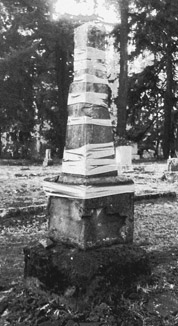
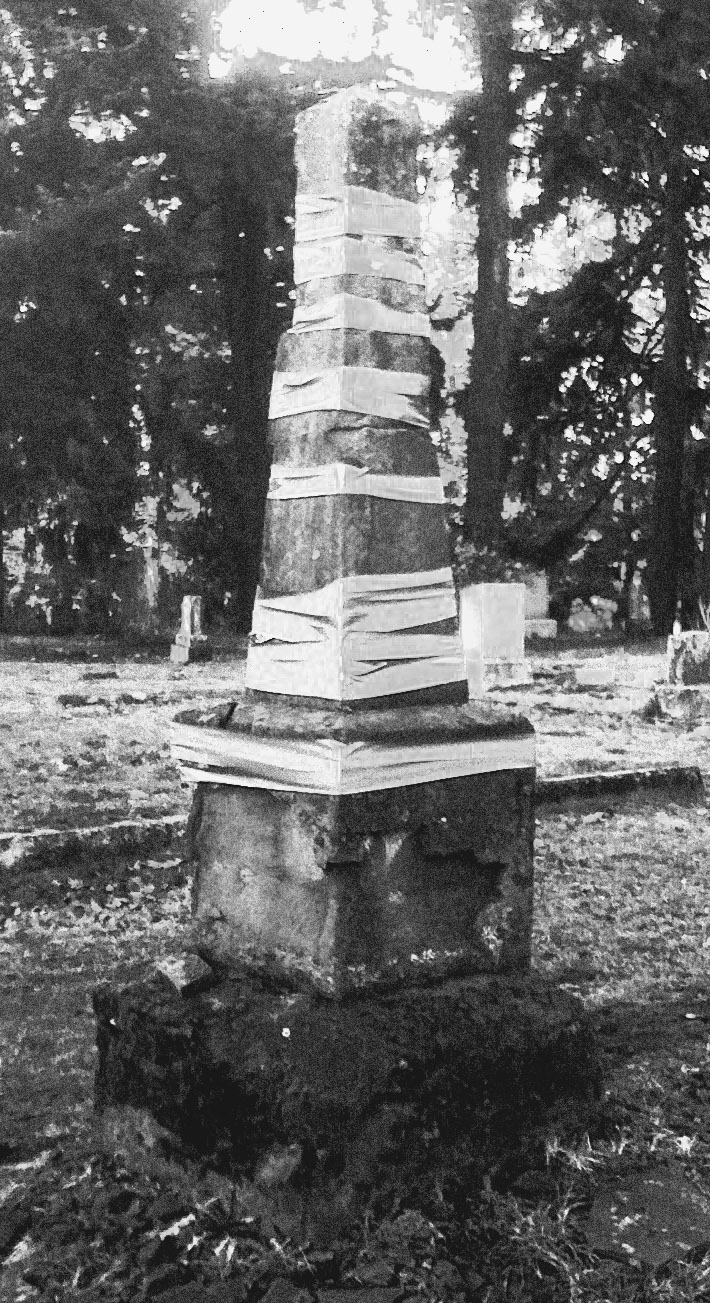
Passing through the cemetery on a late December afternoon, we see a sort of silver specter in the distance ahead. A ghost would not be out of place here where old settlers of Oregon’s upper Willamette Valley rest for eternity. But this is stranger than a ghost. Less believable. And so we move closer, thinking with each step, It can’t be. It really can’t be.

Duct tape. And this was a case of repair, not vandalism. The gravestone was split almost completely through in a few places and in a general process of disassembly. When all else fails, you can hold your family history together with duct tape.

A more standard method of preservation is reliance on memory, which we call  oral history when it happens to other people. Memory is augmented by a handful of puzzling photos of people we know we should be able to identify. We look into stern eyes and rustic homes and feel a sense of pride. But also a quiet concern that we might be proud of the wrong person. Perhaps a cousin or a family friend. If you played Simon in the early 80s, or have walked into a room and wondered why you were there, or have visited an elderly parent who no longer recognized her own child, you know that the only reliable thing about memory is that it is pretty dodgy.

Go back about 150 years, and you’ll find a sturdy Norwegian fisherman stepping onto a larger boat than he is used to, leaving behind the fjord and snow-smothered fields of his youth to jounce across the Atlantic for a new country and, with luck, a new life. Risk, worry, hope, eased by the occasional sour indulgence in lutefisk and the company of his diaspora. It is a nice story if you don’t mention the wife and children left behind.

Now in South Dakota, the settler finds a new wife, Mary, and with her has children whom he names after those he has abandoned in the old country. This gives him two sons named Thor–one on each side of the Atlantic. But his second wife and his second Thor die. So he finds a third wife, with whom he can extend the family, adding a daughter named Mary (after the second wife) and a new son. The third Thor. That is how my ancestor brought the family name to America. This is the story as I remember it being told to me, and there is a reasonable chance that some part of it might even be true. But it is my memory of someone else’s memory of, most likely, someone else’s memory.

A better method of preserving family history is to write it down. That’s why I know so much more about one of my distant ancestors, William Bradford, even though he came to America 250 years before the Norwegian fisherman. Bradford the Pilgrim, holding onto a new home against the toughest odds, recorded in his now-famous diary accounts of starvation and disease, hurricane and earthquake, diplomacy and law (including a strange case that resulted in the execution of both sheep and shepherd).

But equally important stories from more recent generations are slipping away. Half-remembered rumors, conjectures, delusions. The aunt who swears she was orphaned off in her youth while her siblings insist, No, you weren’t. The uncle who mumbled obscenities through evening prayers and went quietly insane. The sister who committed suicide and was rumored to be pregnant. We bury our scandals and defeats as if their past existence could somehow weaken the family line. A history made up not so much of family, but of a name that stands for a family.

Three thousand miles east of the duct-taped Oregon grave, Boston’s famous Granary Burying Ground holds twice as many skeletons as gravestones. Immigrants and patriots began to occupy the cemetery back in the mid 1600s, lying under fantastic slate stones etched with flying skulls and images of Death dancing with Afterlife. But caretakers in later generations were not satisfied. The plots were strewn about randomly. Hard to maintain and not pleasing to later aesthetic sentiments. So the crooked dead were left in their now forgotten spaces while the stones above them were moved and arranged into neat, straight rows.

The dead are inconvenient. Their stories as crooked as the original plots at the Granary. But if past lives don’t align with how we want to see ourselves, they are still an essential part of our history. What we account for as success, after all, is transient. The homes our ancestors built are mostly gone. Farms fallowed and businesses bust. But their struggle is timeless. The struggle for money and shelter, the struggle for meaning and moments of joy, the struggle to set the next generation on its feet. This is our legacy and it is worth preserving. Even if awkward. Even with duct tape.

I think it’s about time we had an Organically Grown certificate for Twitter accounts. As in, “This account is unadulterated by get-followers-quick schemes, pre-scheduled tweets, inspirational quotations from unknown sources, and any link leading to whiter teeth.”

Most of all, it would be nice to know that a community of followers really cared about the ideas being posted and helped shape future posts with their own contributions. Instead, many Twitter accounts today are bloated from reciprocal following, where a person (or a fake person) insincerely follows hundreds of accounts just to cull auto-follows and take advantage of the easily flattered. Like many people, I used to take advantage of auto-follow features in social media tools, thinking that following back was a nice way to thank my new friends. Before long I discovered that my account was following escort services, Southeast Asian freedom fighters, and more get-rich-working-from-home accounts than you can shake an iPhone at.

We need to focus more on constructive relationships, and less on numbers and recognition. As social media consultant Mack Collier puts it, “Social media needs fewer rockstars, and more rockstar ideas.” When I was at South-by-Southwest last year, I saw all the luminaries with their orbiting fans, and even joined a small group discussion with one of them. But I learned the most from a college student who ran a computer lab at a small Texas college, from a New York writer moonlighting at Parsons School of Design, from Ricardo Rabago, the man behind PCC Natural Market’s social media presence. They see their followers as peers engaged in a running dialog about a shared passion. They recognize that a conversation between a few people is much more valuable than a broad communication to 30,000 deaf listeners.

Now that everyone is rushing to join the Twitterverse, there is a growing panic among newcomers that they are too late to succeed. A sense of being stranded on a sinking Web 1.0 island while the social media boat sails away to tropical sunshine. Of being left behind in Backward Town with a flugelhorn in one hand while the sold-out bandwagon rolls off toward the bright city of ROI. And it’s tempting under these circumstances to obsess over getting followers quickly, to rush the growth of the community.

Which is why we need the Organically Grown certificate. To recognize those who build their community one follower at a time, who respond to questions and ideas, who recognize others in the greater social media community, and who lead us, by association, to others who speak to the same passions and do it well. The fast-growing giant gets everyone’s attention, sure, but the naturally grown community is much healthier. It’s not just common sense. It’s true.

Would aliens, if they were to travel across incredible distances to get here, pass right by our lush coasts, our shining cities, our spectacular mountains, and settle in our most barren landscape? The answer is, Apparently So.

Of course, barren is a relative term. If you’ve grown up anywhere along Washington’s western slopes, where it’s green in the dead of winter but you can still see snow on the peaks through the middle of summer, where horizon is mostly a concept useful for people who live in places without so much Douglas fir in the way, well, then barren is pretty much Medical Lake. Driving east from Seattle, you hold your breath for the 200 miles between Cle Elum and Spokane, waiting for trees to reappear. Halfway through, a Chamber of Commerce radio station declares, with no hint of irony, “There is always plenty of free parking in Ritzville.” And then, right at the end of this long stretch, after hours of dust devils and alfalfa and kids arguing and wheat fields and potatoes and more arguing, right at the transition back into trees and hills and curves in the road, is Medical Lake.

It’s here that two brothers from California—following a stint in Wyoming—purchased 21 acres of land along I-90 about five years ago and began filling half of it with bizarre metal and concrete sculptures, most of them manufactured in Asia. You’ll find flocks of dark menacing eagles, statues of naked men with joking signs over their privates, gargoyles, roosters, even the skulls of Texan longhorns tossed into a bin for sale.

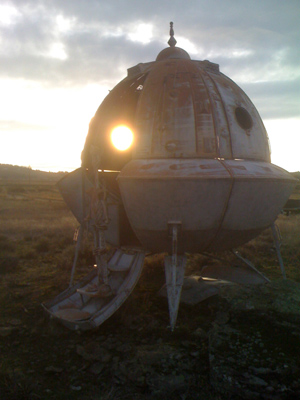
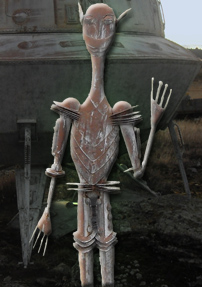
But no one comes here for the skulls. And not many come for the naked men. They come instead to see the UFO and its crop of aliens. The UFO and a seemingly friendly alien are easily visible from I-90. If you take the time to stop by, you’ll find more aliens and even alien-inspired chairs, all on sale.

Just act natural

The aliens and UFO are from China. A life-sized replica of Oscar, the resident dog and security system, is from Thailand. Everything except Oscar is for sale. The owner who met us in November said they had started to get a lot of attention recently from people who found out about the location on the Internet and sneaked onto the property to exchange trinkets. “Geocaching?” I offered. “Yes!” He was irritated by the geocachers because they came onto the property at all hours, without permission, and never purchased a single kitchy statue. We were not purchasing on our visit, either, but at least we were not among the hated geocachers. That is, not until we were halfway to the UFO, when my youngest turned around and shouted back, “We love geocaching! We do it all the time!”

The truth is, our visit had nothing to do with geocaching. Traveling along I-90 in recent years, we had seen the UFO and were beckoned by an alien waving to us from the fenceline. And now, as winter approached, the aliens themselves were on sale for half price at $75. Very hard to resist.

We sat in the UFO, looked around at the myriad sculptures, and talked to the owner about his love of this barren land. This land that grows basalt instead of crops. After years in California and Wyoming, he was home. When I asked what the business, this place, was called, he said simply, “The Farm.” The barren stretch from Cle Elum to Spokane was, to him, the best of all landscapes. And I think that if he were to travel east, he would hold his breath from Couer d’Alene to Missoula, suffocating under the relentless trees and mountains and waiting for the horizon to come back.