Feeds:
Posts
Comments

Eating Virtual Crow

In spite of everything I wrote previously about the Kindle, we have just purchased one as a birthday gift for our 13-year-old. This is what you’d call eating virtual crow.

What convinced me in the end was not a digital appeal but, ironically, a tactile one. It’s difficult for me to separate the concept of reading from the construct of paper, but Nick complained that the paper itself was abrasive. He described turning pages in a book the way a vegan would describe being forced to make haggis. He actually grimaced as he described turning pages, and it tore at my heart. So I thought, I must get him a Kindle, if only as an act of mercy.

We all want our kids to love books. Or rather, we want our kids to love good books. I’m not convinced that good books are available on the Kindle. But I do know that Nick will plow through a goodly amount of prose with a e-book reader. So for now I’m willing to invest in the hope that he can love books the way I do, even if digitally. And I’m willing to abandon the current parent mantra, “No screen time,” when we want to prohibit both television and computer usage. Books are now screen time. I’m willing to cast aside my own prejudice toward paper as the path to knowledge in hopes that the digital alternative will be enough.

And who knows? Vinyl seems to be making a comeback.

Elevator Down

A man gets into our already crowded elevator heading down to the parking garage. He is talking to two colleagues who come in with him, turning aside just long enough to push the P2 button. But his finger stops short. The button is glowing.

Now I am interested. Not in whatever story he is telling, but in the finger hovering in front of a lighted button.

After maybe three seconds of hesitation, he stabs at the button, finishes his story, and relaxes. And I think, What kind of man pushes a button he knows has already been pushed? Is he so compulsive that he needs to complete an action even when it is no longer necessary? Does he re-wash the dishes after his wife goes to bed? I’m thinking that this type of action is somehow important. That there are people like this all around us.

But then we stop and the door opens. My floor. So I head out knowing only that, whatever kind of person he is, he must at least be a very bad man.

GilgameshMy 10-year-old brought home a word this year the way other kids bring home the flu. It debilitated everything it touched and spread quickly from house to house. It was epic. No, I mean literally. The word was epic.

In the same way that the British dumbed down the word brilliant and Americans removed the jaw-dropping power of awesome, a new generation of definition abusers has successfully transformed a word that once represented a series of legendary adventures across time and space into a qualifier for the most mundane things in life. According to my 10-year-old, even a dish of spaghetti can be epic. I should not be surprised. The Odyssey was an epic once. Now it’s a minivan.

Maybe the endless hyperbole of Hollywood movie teasers led people to believe not so much that mediocre movies are epic, but that epic means mediocre. Or maybe it is just that epic in its brevity is easier to text to your friends than the right word. Whatever the reason, I’m not giving in. We already have some pretty good words that mean pretty good. And if something is better than pretty good, we have words for that too.

Why can’t we just bring back groovy?

Infractions

One Car, Lotta Miles
I have been telling people that our van has 300,000 miles on it for about six years. But as of Wednesday, it finally does. For the event, I woke Nick up at 6:15 a.m. and let William drive the half mile needed to flip the odometer. Nick sat in the back aiming his flashlight at the dashboard. The dashboard light itself having burned out long ago. At a quarter mile William ran his first stop sign. I would say that he had broken his first law, but he doesn’t have a learner’s permit yet, so it was actually his second offense. At the  symmetrically beautiful 300,003 we stopped, took a fuzzy photo of the odometer, and switched drivers. I can say in all sincerity that, although the van has now traveled a full 300,000 miles, it looks like it has gone much, much farther.

Two Cars, Seven Wheels

One of these wheels does not belong

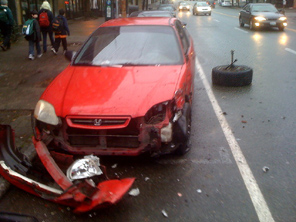
On Saturday I was heading up to the corner of 1st and Wall in downtown Seattle when I noticed that the blue SUV coming toward me had only three wheels. Like a tricycle with a less mature driver.

At the intersection I saw the missing wheel with its axle still attached, aimed skyward. Meanwhile the three-wheeled SUV shoved its nose hard into pavement, hissed and shot sparks, and successfully turned right to head down toward the harbor before crashing into a curb. It is easy to turn right when you are missing your right front tire. It is hard to do much else. It was a hit and limp.

Three Four-by-Fours
Before the Wall Street crash, before the van passed 300,000 miles, I had a minor incident with our own SUV. It was raining hard and we stopped by Papa Murphy’s to pick up a pizza. Should have been easy enough.

“That’s a compact spot,” William pointed out. But he is young and doesn’t understand how these things work. After all, he doesn’t even have a learner’s permit. So I explained that we could park in a compact spot with our oversized SUV if we wanted to. We had a pizza to pick up.

And I almost had the pizza when I got a phone call from Julie. She was sitting in the car alone, watching the man who could not get into his car because there was not enough room in the parking lot for three SUVs to park in three adjacent compact spots.

When William and I came out we found a frustrated man with a pizza of his own, standing in the pouring rain and pointing at our crooked car squeezed up next to his. “You couldn’t even manage to park straight,” he said.

Painted Red

This story begins with a 2’x3′ section of unpainted siding, way up high, and a colleague’s premonition that Julie would fall off her ladder. For the sake of drama, I should point out that there was a rush to get the painting done before driving the kids off to choir practice, and that this was the very last section to be finished before putting the brushes and the five-in-one tool away for the winter. Julie was dressing the house up in bold red–something you’d expect to see in Trondheim or Qaqortoq, if not in Kirkland.Painted Red
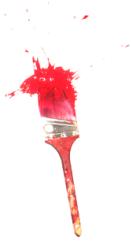
Teetering Against the Tired House
To complicate matters, our house is not shaped conveniently for maintenance. It is shaped like, well, that’s a bit hard to describe. In 1976 a craftsman began assembling what would eventually become our house out of the most unlikely materials and in unorthodox ways. Panes of glass were wedged between 2x4s for skylights jutting out in odd places from the first floor. Cedar siding that should have been installed vertically was installed at an angle. Sometimes but not always. Windows were rectangular, or octagonal, or diamond-shaped. Pick your polygon and it is probably a window here. The house is not two stories or three stories, but somewhere in between. And that is not counting the garage that is halfway below the first story. So if I had to describe the shape of our house, I guess I would say it is a bit like a squished pagoda. Or maybe the Michelin Man with osteoporosis. When it was on the market, we brought my parents out for a tour. After ascending and descending stairs to four levels in two floors, my mother finally sank into a couch in the living room (which is on a level all its own) and declared, This house makes me tired.

So to get to the last unpainted section for 2010, Julie set her ladder at an obtuse angle with its feet in soil next to a heavy concrete planter. In this way she could get over one of the makeshift skylights and up to the second story to paint the 2’x3′ section of unfinished siding. Do not, by the way, forget about the concrete planter. It came with the house and, at the time of the accident, was filled mostly with shotweed.

Slippage
The premonition, as it turns out, was an oversimplification. Julie did fall off her ladder as soon as it began to slip out from under her. But then, after bouncing off and cracking one of the unorthodox skylights, she managed to catch the ladder and get back on to continue the ride down. No doubt she made sure to hold on to the container of red paint to keep it from spilling out and going to waste. I found it the next day, still full of red paint with a brush neatly set beside it. She would remember later that she was also concentrating on her legs, and that she must keep them above the ladder so they wouldn’t break. Soccer season coming.

Inside the house, 10-year-old Tom was upstairs (doing homework, we’ll assume), while William and Nick were downstairs (also surely doing homework). They did not hear the ladder slide, or the skylight crack, or what came next.

Thud
Back on the ladder, Julie gripped and slid and tumbled down until at last she struck the concrete planter hard enough to fracture her spine, break her ribs, and puncture a lung. Literally out of breath, she gasped for attention and crawled a few yards before collapsing. If you are counting, you know that she fell off the ladder, then onto the ladder, then off the ladder again.

Tom did not hear sliding or scraping or any thud, but by some miracle he heard the faint gasping and he called for help. The older boys quickly set about taking care of their mother, with one on the house phone for a medic and the other on a cell phone to me. Tom peered out of an odd-shaped window from the second story as the medics came and put his mother in a neck brace, on a gurney, and into an ambulance. The medics would also leave a neck brace behind, which Nick tried to return to the hospital a few days later. In case they needed it.


Painted Red
Thanks to the level-headed work of three incredible sons, I reached the hospital before my wife even arrived. I heard the announcement of a trauma pulling in and was able to be there when she emerged covered in splatters of red blood and paint from head to toe. The doctors carefully assessed her injuries, the nurses caringly addressed her needs, and a technician who was trying to clean her up said, “I can’t seem to get this blood off… Wait, what were you doing?”

While the x-rays were being reviewed a social worker came by and thoughtfully asked Julie if perhaps she had fallen off the ladder while painting in a drunken stupor. The social worker was wise enough to have me step out of the room before asking this question. Which is why there was only one trauma case that day.

Titanium Wife
The first assessment failed to identify the severity of her injuries, and the first surgery failed to fix them. After a second surgery, with eight screws and two rods comprising “not more than a pound” of titanium, Julie is finally home, mostly off pain medication, and able at last to engage in physical therapy such as cleaning dishes, lifting laundry, and other activities that seem natural to a person who would try to keep paint from spilling while falling off a ladder. As far as coping with the broken ribs and punctured lung and titanium back goes, she says, “You know exactly how many times you have sneezed every day.”

For the record, I was able to paint the 2’x3′ section of unfinished siding by leaning out of a second-story window with a paintbrush fixed into a long bar clamp. Please don’t tell my wife.
Rubber Band Wallet

I saw an old Chinese man at Costco pushing his wheelchair-bound wife through the checkout line. His life seemed complicated, with language and aging challenges, a partner who needs extra care, and a cartload of bulky Costco items to haul around. But he had simplified his life in one astonishingly practical way.

He had a rubber band wallet.

It was a single, fat blue rubber band holding together all his credit cards and IDs and photos. I thought, in the new cash-free economy, this rubber band wallet seems like a pretty clever idea. And I was reminded of a man I photographed in China in 1991 who made a business out of transforming old bike tires into shoes. I was also reminded of my father, who fixed exhaust systems with coat hangers and installed a phonograph in his car before 8-tracks or tape cassettes or CDs existed.

I love seeing people solve sophisticated problems with unsophisticated solutions. And yes, the man at Costco was most likely just cheap. Like my father was cheap. But the ability to stay in the game when you are dealt a poor hand is admirable. And I think it can be an addictive way of looking at the world. I have a few shot bike tires in the garage, and right now I am looking at my shoes.

The Finger

There was already a bit of tension in the air as the mountainous contractor surveyed our aggregate concrete floor to bid on a refinishing project. I’m sure he was trying to figure us out as much as he was assessing the job. Were we cheap? Were we well off? Were we well off but cheap? People can be hard to read.

At last he came to an estimate of what we would be willing to pay: $1,000.

Julie was taken aback, and then the screaming began.

It was not Julie screaming, even though she may have felt like screaming. It was not the contractor, left standing with his “$1,000” hanging in the air like a dirty joke he could not untell.

It was Tom, who had just caught the tip of his fingernail in a door he was slamming shut. He ran by the contractor in three directions, screaming and waving his hand like a bright red paint brush. Blood on his clothes. Blood down his arm. Blood across the dirty aggregate concrete that was apparently so expensive to clean.

So I ran down from upstairs and did my best to calm myself while attending to a child whose fingernail was held on by just a thread of skin now, flapping back and forth like a cat door.

The contractor waited for some peace to return, and then ventured quietly, $600?

And Hell broke loose again. “I don’t want to go to the hospital! I don’t want to go to the hospital!” Tom paced around frantically trying to reason with his father. “I don’t want to go to the hospital!”

Julie called off negotiations with the bewildered contractor: “I think you’d better leave.” And he was gone.

An hour later, peace and quiet had returned for good. Tom did not have to go to the hospital. I cleaned up the blood where I found it, and then quietly retreated to trim my own fingernails.

Just to be on the safe side.

This article was first published on Technorati.

Little Hope for ChangeHe was portrayed as a cockroach in the movie Team America. He was portrayed as a drunken lecher by his former sushi chef. And much less convincingly, Kim Jong-il has been portrayed as a brilliant and benevolent leader whose travels are often accompanied by miracles in the natural world. This week, as expected, his son Kim Jong-un was awarded various official titles by the Workers’ Party of Korea and seems destined to become third and final dictator of the world’s last remaining Stalinist regime. Will we miss the Kims?

It is difficult to imagine the world without its parallel universe–a version of reality that has fascinated me ever since I heard my first North Korean propaganda while living in China in the early 1990s. Every day I tuned my shortwave radio to pick up the afternoon broadcast with its excoriations of fascist cliques and puppet regimes, all delivered in clipped, colorful English. A song called “Women are Flowers” would be followed by a report that black Americans live in concentration camps where they are shot at random. A report on the Committee for the Peaceful Reunification of Korea would be followed by a brass band playing “Death to the Aggressors!”  It was irresistible.

But if the regime’s depiction of the world was a bit hard to believe, its actions were even more improbable. Submarines abducted children from the coasts of Japan and spirited them off to North Korea to help train spies. Tree pruners in the Demilitarized Zone were murdered with their own gardening tools, while below the surface workers dug at least four giant tunnels, each capable of passing an entire emaciated infantry battalion per hour under the border to South Korea.

Farther from home, North Korean bombs killed South Korean officials in Burma and blew a Boeing 707 filled with civilians into the Andaman Sea.

With Kim Jong-il’s ascension to power in the mid 1990s, the regime turned its efforts to destroying the economy, starving its citizens to death, and shooting them in the back when they tried to cross the Yalu River in search of a better life. Military achievements included rockets that failed to reach orbit, a nuclear explosion that misfired, and most recently the successful torpedoing of a South Korean ship patrolling its own waters. Not keen to take credit for this one success, North Korea decried international investigations  “into the sinking of a warship of the south Korean puppet navy in a bid to hurl mud at the north.”

So after more than 50 years of Kim family rule, let’s not get nostalgic. Yes, Kim Jong-il put pomp in the pompadour.  And maybe he and his father really were attended by miraculous blossoms, magical fogs, and glorious double rainbows. But surely we’ve had enough of the family.

Fart Egg

SylviaSylvia’s dysfunctions are many. She tries to sleep on top of her house instead of inside it. She pecks at the other chickens and has trouble keeping friends. And worst of all, she is always finding new ways to fail at laying a proper egg.

She has laid small eggs with translucent membranes instead of hard shells. She has laid normal looking eggs with soft shells, and eggs with hard but misshapen shells. She has even laid eggs with no shell at all. Yuck.

And then there are the wind eggs. A wind egg is normal in appearance but has no yolk inside. I call them wind eggs because it is a widely accepted term for the phenomenon, and also because it carries a certain sense of mystery with it. But there is another common term for a no-yolker. The fart egg. I cannot quite bring myself to use this term. For one thing, it does not have any sense of mystery at all. Just the opposite. And of course I am a mature adult. “Sylvia has given us another wind egg,” I’ll say. Then one of the boys will correct me. “You mean she laid a fart egg, Dad!” The others giggle. My wife laughs. I am surrounded by immaturity.

Fine. Laugh at me. I tell them that there are also many terms for a chicken that cannot lay proper eggs. Casserole. Cacciatore. Cordon Bleu. The boys pretend I’m joking.

Now, to her credit, Sylvia is getting better at laying proper eggs. The kind you would not be afraid to give to a nice neighbor. Her other eggs we can give to neighbors we don’t like.

This post first appeared on Technorati.com.

This could be you.It was just one week ago at pii2010 that Jeff Jarvis scoffed openly at our culture’s obsession with privacy. Very soon, he predicted, it will be considered selfish for people not to share a bit of themselves online. Sharing, after all, is at the very heart of almost every innovation these days. We steer complete strangers to our favorite restaurants. We help pharmaceutical companies create more effective drugs. The value of personal information is undeniable. But just days after Jarvis’ prediction, we find a new and interesting twist. Now you can give up your personal data for the most unabashedly selfish of reasons–profit.

A New York start-up called Statz has just announced the debut of its online service, enabling users to sell their personal data to businesses–everything from cell phone records to eBay transactions to OnStar data.

It’s a fascinating concept. Maybe even a sound one. But there is one kind of personal information that is not to be shared just yet. If you agree to participate in the Statz Marketplace alpha trial, you are forbidden under the terms and conditions from writing online about your experience until the full, public product launch.

For businesses eager to dig into my personal data prior to the official launch, I can share a few insights here:

  • AT&T Wireless Revelations
    – I pretty much only call 3 people
    – I can never get my wife to answer her cell phone
    – My wife apparently screens her calls
  • OnStar Data Revelations
    – I can’t resist oddly named towns like Humptulips
    – Small children can’t resist pushing the bright red OnStar emergency button
    – I am too cheap to make the jump from analog to digital OnStar

Please note that I am providing the above insights from my personal data free of charge. In the future, I expect to be compensated based on the going market rate.