Feeds:
Posts
Comments

Cloudy Pisgah

View from Pisgah

View from Pisgah

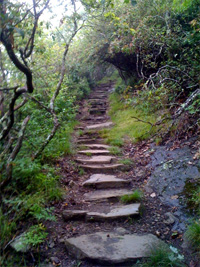
It might be true that I climbed Mount Pisgah in part because the name made me giggle, but Pisgah is not funny. Pisgah is a serious hill in the Blue Ridge Mountains of  North Carolina that gets to be called a mountain because it is taller than everything else around it. The hike up Pisgah is very nice. You pass a lot of people in flip flops who would look out of place on a real mountain. And if you hike past them with a backpack as I did, they will stare at you as if you were some sort of strange nerd. Because hiking Pisgah with outdoor equipment is like taking a tent and survival gear to the cinema in case a storm blows in while you are watching Harry Potter and the Chamber Pot of Pisgah. Or something like that.

Path to Pisgah

Path to Pisgah

The Mount Pisgah in North Carolina is named after the biblical mountain from which Moses first saw the Promised Land. In both places one should have an expansive view over promising territory. Moses in his excitement might even have marked this territory as his, but the Old Testament is silent on that Pisgah’s etymology.

When I climbed Mount Pisgah, I passed flip floppers who scoffed at me. I passed cigarette smokers who coughed at me. And at last I reached the summit where I could look around and see an impenetrable fog in all directions. I thought of all the times I had climbed for hours and hours in the towering Cascades, daring avalanches and crossing dangerous terrain just to have this exact same view. White cloudy foreverness. Moses doubted and struggled, but at last he saw the Promised Land stretched out before him. Whereas when I was on Pisgah, people just peered into the fog and said, “Wait, is that Greenville down there?”

For my first trip to the Ozarks, I made sure to pack the essentials for hiking in 106 degree weather: mosquito repellant, sun tan lotion, and a book about the Siberian Arctic. If you can’t keep cool, you can at least submerse yourself in freezing literature.

What I did not bring was a map because St. Louis has its own REI, so I could pick a map up on my way from the airport. Trouble is, the REI in St. Louis doesn’t actually sell maps of the Missouri backwoods. It sells running clothes and dog toys and bags of smoked salmon from Anacortes, Washington. I settled for the salmon and moved on to the Whole Foods next door where I found Washington wine and Bing cherries–also from Washington. If I got lost, I would have comfort food.

My freezing book, In the Land of White Death, had everything you could ask for in a true-life tale of survival. A bunch of guys slogging for months across unstable pack ice, drowning and starving and hallucinating about hot places like the Ozarks in July. On the plane ride from Seattle to St. Louis, after years of looking at this book on my shelf at home, I finally had a chance to read it.

The drive down to Mount Bell was interesting. Once in the Ozarks, I found quintessential backcountry things to photograph, like a drive-through window for cigarettes with an enticing “Cheap Smokes” sign; a tremendously oversized American flag completely enveloping its undersized staff like some sort of Christo exhibition; and a John Deere baseball cap on the side of the road with rolling hills in the distance. I took these pictures so I could remember my trip to the Ozarks. And at the Mark Twain National Forest Potosi Ranger Station, I even found a brochure with enough topographic lines to serve as a map. I was ready to join the rest of the backpackers heading to the state’s best summit.

Except that in July, no one climbs Mount Bell. Something about the 106 degree heat, humidity, and biting bugs keeps people away. So I had the mountain to myself, which was just fine with me.

Because of the heat, I waited until late afternoon to leave the trailhead, arriving at the summit shortly before sunset. This is not your narrow, jagged Cascade summit. On the top of Mount Bell, you can wander through the low forest and over broad reddish boulders to get a view in almost any direction. I found a good campsite on the edge of a cliff looking east. Set out my gear. Wandered about the summit. Enjoyed my salmon and cherries and wine as the sun dropped into a bank of western clouds. And I spent some time with my book, In the Land of White Death.

It was 1912. There was a ship of unlucky Russians stranded ice-bound above 71 degrees north, waiting to die. But a few brave souls dared to walk across hundreds of miles of shifting slabs of frozen ocean, dragging heavy tents and makeshift kayaks behind them in an attempt to reach the Franz Josef Archipelago before another winter set in. After weeks of near starvation they began to find game to hunt. The author reveled:

Seal brains fried in seal oil also taste very good. The front flippers, well baked, are reminiscent of calves’ feet.

For some reason, this passage struck me as particularly beautiful. I set the book down and searched through my things to find a pencil. Ever since my first reading of Moby Dick more than twenty years ago, I have kept an index of beautiful phrases and their corresponding page numbers in the back of every book I read. In this case, I decided to simply write “Eating Seals 49.” 

So you can imagine my surprise and horror when I discovered a penciled note already inside the back cover that read: Eating Seals 49.

There was only one logical conclusion. I had already read this book. I had been struck by the exact same passage, and left the exact same note in the back. Yet I had no memory of reading the book. It was as if my future self had come to visit in a time machine and left graffiti on my wall. Not funny.

And then the sun was gone from the Ozarks. From darkness the moon came out to illuminate the canopy of treetops below me, and the canopy itself seemed to float above the black world below it. And across this dim canopy a thousand fireflies began to flash like lightning in an upside-down storm. Or was it more like synapses misfiring in the ever-darkening brain? I looked out across this spectacular flashing world with an idle camera in one hand, knowing that the camera could not capture its beauty. And I wondered if I would remember this moment in the hot and humid Ozarks, and this feeling. Or if I would one day look back at my photographs and remember only a drive-through window for cigarettes, and a flag so heavy it had never known how to fly in the wind.
New Mailbox

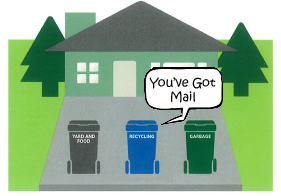
Sometimes the benefits of being annexed by a neighboring city are not immediately clear. When the City of Kirkland closed our park at Juanita Beach and forgot to reopen it, for example, I failed to appreciate it. I was also puzzled when our garbage and recycling bins were taken away last week. But this week the bins were replaced with new ones, and they came with a surprise.

Taped up under one of the lids was a note that looked a lot like junk mail. It turned out to be important tax information with the following explanation:

Dear Finn Hill, North Juanita, and Kingsgate Resident,
You recently received a City Service Guide in the mail that we hope you find to be a helpful and useful resource. Unfortunately, the 2011 Property Tax Comparison on page 23 is incorrect; please replace it with the correct version shown below.

In other words, “We sent you inaccurate tax information by mail, so to make things right we are delivering the corrections to you in a garbage can.”

Makes sense to me.

Don’t Share the Road

Cyclist BustedSomeone across the street from our office used to hang a fat-lettered sign inside their 5th-story office window that read: WARNING: SPEED TRAP. The sign alerted drivers at the intersection of NE 8th and 112th Avenue NE in Bellevue that they were being watched. But it isn’t exactly a speed trap. The intersection is complicated mess, with drivers entering from more 19 lanes of traffic including a 3-lane offramp, plus inconspicuous no-right-on-red signs and an onramp to top it all off. With every green light and so many drivers trying to navigate through the maze of lanes and restrictions, someone is bound to break a law. And most mornings a Bellevue motorcycle patrolman is there to catch them.

Up on the 8th floor of my office, across from the warning sign, I am used to the brief blip blip of the siren that tells me someone is being pulled over. I wheel my chair over to look down with curiosity at the misfortune of others, or Schadenfreude if you are German. The Bellevue police can  be more disruptive to workplace productivity than Spider Solitaire.

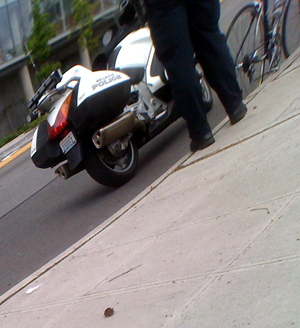
But occasionally, the routine is broken. One overcast day last week things did not go as planned for the Bellevue police. There was no blip blip for an interminable 10 to 15 minutes of green lights. The silence got my attention. I looked down and saw a motorcycle officer spying from his hideout. Ponch and John had been reduced to John with paunch. No driver was willing to commit an infraction. He looked bored. So at last, he drove his motorcycle through the crosswalk and nabbed a middle-aged woman waiting for the light to turn green. She was on a bicycle.

As a cyclist who often deserves to be cited, this really caught my attention. How could you get a ticket for just waiting at a red light? I ran down the stairs, camera phone in hand. I snapped a bad photo of the legs of the officer as I walked by. And then, when it was all over, I found an excuse to talk to both the cyclist and the officer.

She seemed a little bewildered and swore she had not done anything wrong. But for a trained officer, the offense was obvious: The cyclist waiting for a light to turn green was “splitting lanes.” At this particular intersection, that means that she was waiting on the far right of the through lanes and allowed a car to pull up alongside her. She thought she was being polite by not getting in the way of cars waiting to go through the intersection. But she should have been impolite. By allowing a car to pull up next to her in the same lane, she had violated a law designed to keep motorcycles from driving between cars on the freeway.

The last part of my snooping was to find out how much the cyclist had been fined for letting a car pull up next to her. Fortunately for me, the Washington State Patrol has an active and helpful Twitter account. And the answer is: $124. Sometimes it is best not to share the road.

Splitting Lanes

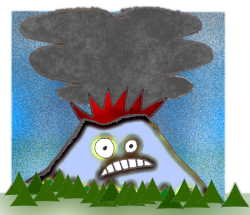
Mount St. Helens on May 18, 1980I may not be able to remember my own mother’s birthday, but I cannot forget that today is the 31st anniversary of Mount St. Helens’ greatest eruption in recorded history, May 18, 1980. Back then I was just a kid in Lacey, Washington, living through a remarkable spring of small but continual volcanic activity. Minor earthquakes reminded us every month that something really big was on its way. Small eruptions whetted our appetite. And every few days we would trek up to the top of the neighborhood hill to stare at the clouds. Every cloud we saw was from a volcanic eruption. We knew it.

Then things got serious. My oldest brother returned from an aborted fishing trip in a station wagon that was completely covered with three inches of volcanic ash. We scooped the ash into plastic bags to save for the future, and waited for an ash cloud to float our way.

We were ready when it came with our surgical masks and an eager sense of doom. For about 45 minutes the bright afternoon sky turned dark gray and ash flitted down like prehistoric dandruff. More bags emerged to gather evidence.

Then it was gone. Bright skies returned and we were left with our dingy masks and a memory of the day world history had graced us with recognition. It did not seem like much, but at least we had our bags of ash. By the end of 1980, we had hundreds of them.

But there was a glut on the market. Anyone driving from Seattle to Portland  in the 1980s passed thousands of tons of volcanic ash piled up along the rivers.

Many years later I went looking for the bags of ash, but they were all gone. I accused my mother of discarding them. She denied it. Maybe I should have remembered her birthday.

Twitter HaikuThe first haiku I will not share with you in haiku form. It was constructed strictly to win a contest, and I’m not talking about a beauty contest here. At stake were ten new  BlackBerry PlayBooks, to be awarded to the ten best haikus published on Twitter about the new device.

The contest was beautifully simple: Tweet an original haiku about the new BlackBerry PlayBook while complying with the following restrictions:

Rule 1:
The poem must consist of three lines of 5, 7, and 5 syllables respectively.

Rule 2:
The poem must not mention competing products (Read: Don’t mention the iPad).

But most of the entries went something like this:
          Please for God’s sake give me
          A PlayBook  cuz I wanna win really bad!
          Down with iPad!

This created somewhat of an unfair advantage for winning contestants like Lisa Akari who knew how to follow rules, knew how to construct elegant haiku, and were familiar with Basho. Her approach was to honor the form while having fun. Sadly, there is also a low road to victory.

My approach was to create the kernal of a hypothetical marketing campaign. To be honest, I’m a little in love with my concept, but my execution through haiku was ungainly, like the debut of a beautiful model in ill-fitting clothes. So in this blog post I’m pulling it out of haiku and presenting the concept alone.

I wanted to convey a sense of universe-at-your-fingertips awe about this new tablet computer. I wanted to capture the feeling you would get if you could have this power with you wherever you went, from an evening at home to an afternoon at the neighborhood coffeeshop to a rained-out vacation on the Oregon Coast. All accessible through a tablet computer. I came up with this:

Haiku 1 Tagline Concept
Columbus was wrong. The world is flat.

I do think this is much more interesting than the official PlayBook tagline: “The world’s first professional-grade tablet,” which violates Rule 2 in spirit even if it does not name the iPad explicitely, and has readers reaching for their Chicago Manual of Style: Is that a compound adjective and do I need a hyphen?

So yes, I prefer my approach and I want to see it used in a new marketing campaign. That would be the greatest prize of all. But getting a brand new PlayBook is a decent consolation prize and I’m eager to get that into my hands as well. When you enter a contest on Twitter, there is always a little bit of doubt: What if the contest is a scam? What if the Twitter @blackberry account is run by some pimply teenager in Medicine Hat (the Gas City), Alberta?

I have to admit I started to worry after getting the initial “You’ve Won” announcements and then not hearing much more. So I sent the following haiku to fellow winner Lisa Akari as we were both waiting for updates:

Tagline Haiku 2
     Blackberry haiku
     Sweet promise, like morning mist
     Evaporating

But then I checked my email. There was a notification about my winning entry and a new form to fill out. This time they asked for my social security number as well as a written signature. So at last I will receive my new PlayBook as a genuine winner of the haiku contest. Or I will provide my social security number and signature to some scam artist in Alberta.

It is hard, sometimes, to separate the hope we have for tomorrow from the coarse reality of the moment. As  Matsuo Basho recorded in The Narrow Road to the Deep North:

     Bitten by fleas and lice,
     I slept in a bed,
     A horse urinating all the time
     Close to my pillow.

Spring cleaning, chicken style

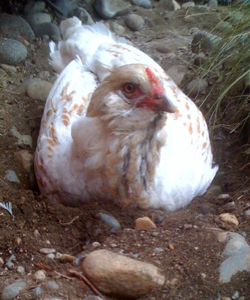
Spring has arrived in Kirkland, which means that the daffodils are blooming, the rain-soaked hills around us are sliding toward Lake Washington with $900,000 homes in tow, and everyone is engaged in some sort of spring cleaning. For the chickens, spring cleaning means rolling around in the dirt as much as possible. Theoretically the dirt baths keep parasites at bay, but I know a kid who bathes regularly in dirt and still managed to get head lice. Anyway, the chickens clean up well enough in the rain which has not ceased since March 1. Julie spent a full four hours this afternoon at William’s track meet in a relentless downpour. Which she did as the better, more dedicated parent. I told her that I was looking forward to seeing the two of them back at our warm house so she could give me a big wet Willy. Which she did not think was funny. But I believe that as long as I am able to amuse myself, that will be enough to get me to summer.

Auf Wiederzune

This post first appeared on Technorati.com

Most people reading today’s headline that the Zune is finally dead will be asking the same, bewildered question: The what?

If you can’t remember what exactly a Zune is, you are not alone. Set your time machine back to 2006 when Microsoft released its own portable music player to challenge Apple’s iconic iPod.  To make inroads into Apple’s style-conscious fanbase, Microsoft released it’s new product in three colors: Drab, Blah, and Yawn. I got my Zune from the next generation in which the color choice had been expanded. It was gray. Oh yes, the Zune did come with an FM radio, which was a feature the iPod did not have. This came in handy when you ran out of songs from the seriously limited Zune Marketplace.

But I loved my Zune. Yes it was clunky and would not let me share music between my own computers, but I used it to create the soundtracks for many a road trip, from the Redwood Forest to the Gulf of Georgia (that would be Canada). My kids asked to get Zunes for Christmas and I didn’t have the heart to tell them that Santa owned an iPod.

In 1991, Geoffrey Moore explored the difficulty of taking a product from early adopter to mainstream consumer in his besteller, Crossing the Chasm. That’s the usual focus of attention–products that have made the leap successfully. We want to forget about personalized home pages and New Cokes and new Gap logos. But they are interesting studies in how companies catapulting through endless success can suddenly fall into cataplexic failure by simply not paying attention to its customers.

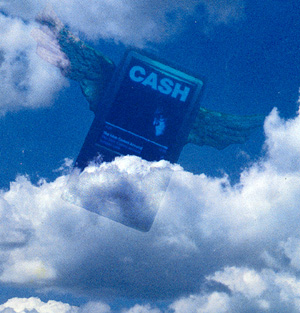
Microsoft got to the edge of the chasm and looked down instead of ahead. At the bottom of the chasm you find people like me, buried beneath a rubble of HD DVD players and worthless dot-com stocks. And faintly, with a failing hardware connection and the battery running out, you can hear a lonely Zune playing Johnny Cash, and he is singing about the end of the world.

Flaming Geyser [sic]

The first thing you should know about Flaming Geyser is that it is not flaming. It is also not a geyser. In fact, pretty much everything about the namesake of Flaming Geyser State Park is connected to disappointment. It was created inadvertently back in 1911 when coal miner Eugene Lawson drilled a borehole to find coal and penetrated a layer of salt water and methane—this just 11 months after a methane explosion at the nearby Lawson Mine killed 16 miners and wiped the town of Lawson off the map. He returned 11 years later, lit the bubbling mix of water and methane coming from his test hole, and Flaming Geyser was born. Supposedly it shot 25 feet in the air at times, and was at least significant enough to be interesting until someone tried to improve the show with dynamite in the 1960s. After that it burned about 10 inches high, and subsequent earthquakes drained the power further. Now the flame is rarely more than few inches, when it is burning at all. Online reviews of Flaming Geyser State Park are often filled with bitterness.

Unflaming Ungeyser Notwithstanding…

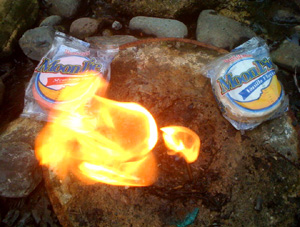
Flaming Geyser with Moon Pies

Flaming Geyser with Moon Pies

My son Nick and I set out this weekend on a hopeful journey to explore the Green River and its peculiar attraction. Nick came prepared with two survival kits, including food and water, medical supplies, and a knife and flint. You just never know. Along the way we passed by Taylor Mountain, where Ted Bundy deposited so many of his victims (I did not mention this). To Nick it was a beautiful wilderness paradise, even if I saw it through a glass darkly—could almost make out ghosts standing along the roadway hoping for a ride home. We hit three small towns, picked up two moon pies, and at last came to the Green River, where Gary Ridgeway left many of his victims (I did not mention this either). Nick marveled at the beautiful ice along the river bank and jumped fearlessly from rock to slippery rock until I could not help but mention the number of swimmers who drown every year in the Green River. Not to spook him, but the place is clearly cursed.

Two stops and a few miles later we turned at last down Flaming Geyser Road and into Flaming Geyser State Park. At the end of the road there was a short trail past a hopeful sign for Flaming Geyser and Bubbling Geyser. We had reached our destination.

There was no flame. Just a bubbling hole in a concrete circle in the middle of a pit. But we had not come all this way to be disappointed, so Nick went to the car and returned with the knife and flint from his survival kit. A few scrapes and sparks later he had the geyser flaming in full 2-4 inch glory. Until the wind blew it out. So in the end, it was a pretty good road trip, with one do-it-yourself flaming geyser, two moon pies, and a lot of father-son time.

Yellowstone be damned.

Sign of the South

Bennett's Point, SCBack in the beautiful Carolinas on business, I take advantage of a sunny Sunday to drive out to Bennett’s Point where the welcome sign features a giant mosquito and the phrase, “Gotta Love It.” Luckily it is early February, and the only thing flying around by the thousands is the white ibis.

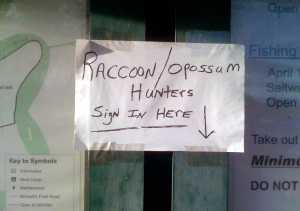
On Bear Island there is a registration station with a nice map of the area and an alert for possum hunters. Nearby another sign warns, “Hunt Underway.” I opt not to hike around the area because I share many attributes with the possum, like feigning death under pressure, smelling bad, and hissing.

So I drive out of Bennett’s Point, and at last, in the distance, I can see a familiar sight for someone from the Pacific Northwest–a black crow disassembling a roadkill squirrel. Except that as I drive closer, the squirrel starts to look less and less like a squirrel, and the crow begins to outgrow any crow I’ve ever seen. I stop the car at the scene, leaning out to photograph the black vulture standing over its dead armadillo. But the vulture is spooked and flies off with an eerie whup whup whup.

That was yesterday. Tomorrow is another full day of work, and then it’s off to see the mountains where Doc Watson grew up. And maybe I can explore them if it’s not raccoon season there.