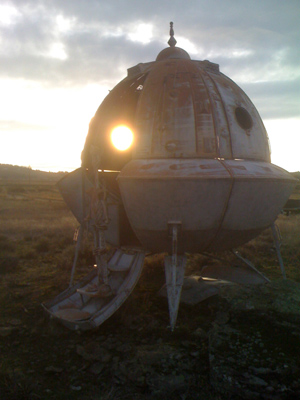
 Would aliens, if they were to travel across incredible distances to get here, pass right by our lush coasts, our shining cities, our spectacular mountains, and settle in our most barren landscape? The answer is, Apparently So.
Of course, barren is a relative term. If you’ve grown up anywhere along Washington’s western slopes, where it’s green in the dead of winter but you can still see snow on the peaks through the middle of summer, where horizon is mostly a concept useful for people who live in places without so much Douglas fir in the way, well, then barren is pretty much Medical Lake. Driving east from Seattle, you hold your breath for the 200 miles between Cle Elum and Spokane, waiting for trees to reappear. Halfway through, a Chamber of Commerce radio station declares, with no hint of irony, “There is always plenty of free parking in Ritzville.” And then, right at the end of this long stretch, after hours of dust devils and alfalfa and kids arguing and wheat fields and potatoes and more arguing, right at the transition back into trees and hills and curves in the road, is Medical Lake.
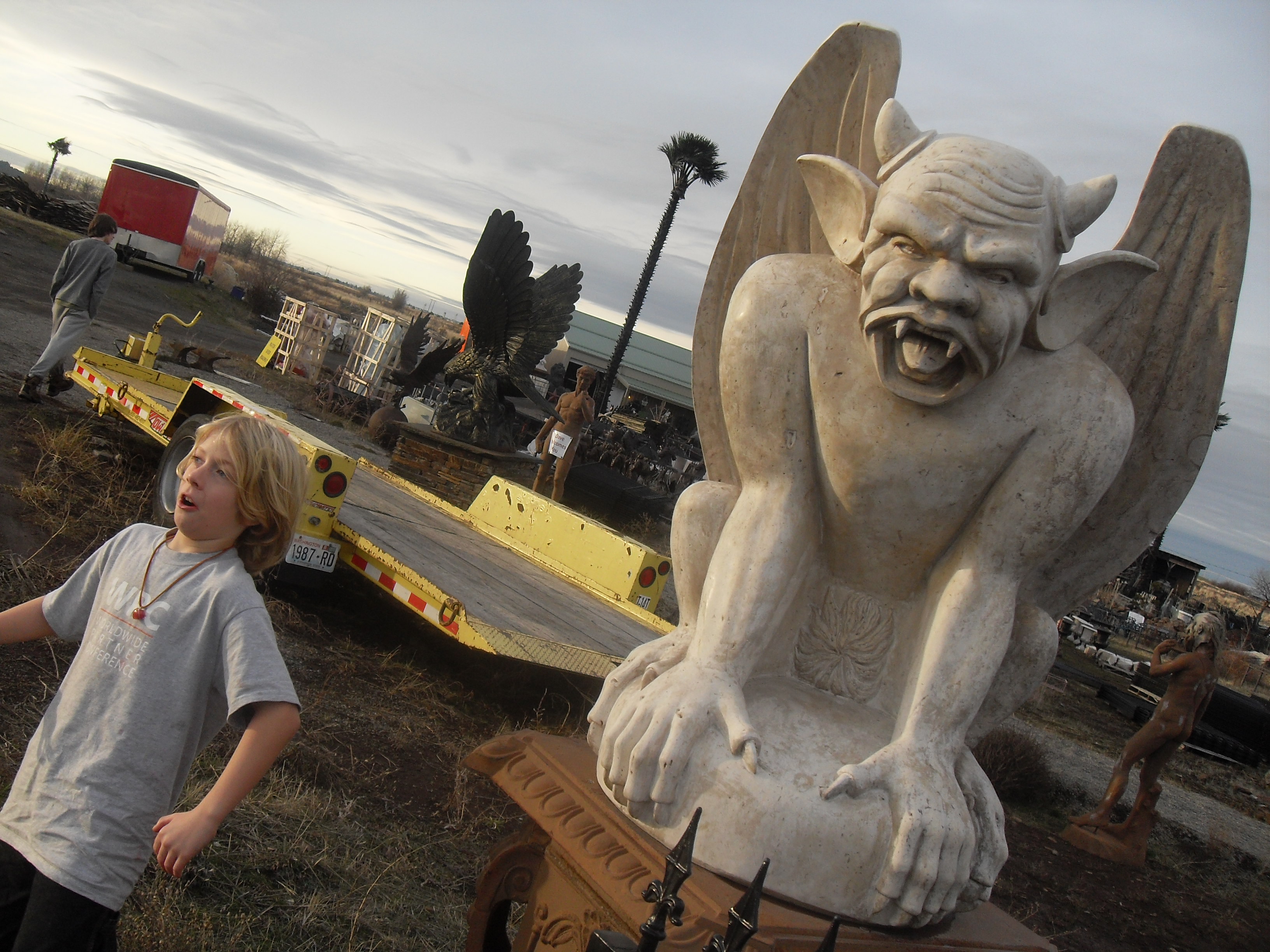
It’s here that two brothers from California—following a stint in Wyoming—purchased 21 acres of land along I-90 about five years ago and began filling half of it with bizarre metal and concrete sculptures, most of them manufactured in Asia. You’ll find flocks of dark menacing eagles, statues of naked men with joking signs over their privates, gargoyles, roosters, even the skulls of Texan longhorns tossed into a bin for sale.
But no one comes here for the skulls. And not many come for the naked men. They come instead to see the UFO and its crop of aliens. The UFO and a seemingly friendly alien are easily visible from I-90. If you take the time to stop by, you’ll find more aliens and even alien-inspired chairs, all on sale.
Just act natural
The aliens and UFO are from China. A life-sized replica of Oscar, the resident dog and security system, is from Thailand. Everything except Oscar is for sale. The owner who met us in November said they had started to get a lot of attention recently from people who found out about the location on the Internet and sneaked onto the property to exchange trinkets. “Geocaching?” I offered. “Yes!” He was irritated by the geocachers because they came onto the property at all hours, without permission, and never purchased a single kitchy statue. We were not purchasing on our visit, either, but at least we were not among the hated geocachers. That is, not until we were halfway to the UFO, when my youngest turned around and shouted back, “We love geocaching! We do it all the time!”
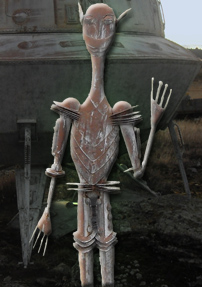 The truth is, our visit had nothing to do with geocaching. Traveling along I-90 in recent years, we had seen the UFO and were beckoned by an alien waving to us from the fenceline. And now, as winter approached, the aliens themselves were on sale for half price at $75. Very hard to resist.
We sat in the UFO, looked around at the myriad sculptures, and talked to the owner about his love of this barren land. This land that grows basalt instead of crops. After years in California and Wyoming, he was home. When I asked what the business, this place, was called, he said simply, “The Farm.” The barren stretch from Cle Elum to Spokane was, to him, the best of all landscapes. And I think that if he were to travel east, he would hold his breath from Couer d’Alene to Missoula, suffocating under the relentless trees and mountains and waiting for the horizon to come back.
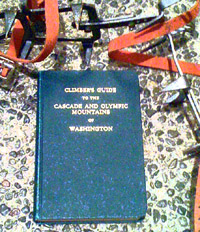 That would be Fred Becky. The man who almost single-handedly defined climbing in the Northwest, who made more first ascents than anyone in recorded history, who will scale a cliff with thousands of feet of exposure more easily than most of us can cross the living room.
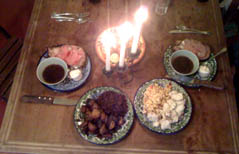 It’s not every year you dress up and bring your candles to the butcher shop. But this isn’t like most years. Money is tight. Jobs are scarce. The future is more than just a little hazy. In other words, it’s time to get creative. So rather than go to one of Seattle’s great restaurants on our night out, we opted to go directly to the butcher that supplies the best of them. The Butcher Shop Cafe on Juanita Drive is not exactly your ordinary butcher. You can order everything from kielbasa to guinea fowl and have the chef prepare it right there. This Saturday we had prime rib, which was outstanding. For side dishes we pretty much ate everything available, including baked corn salad, beans with brisket, and sauteed squash and peppers. The cafe is more utilitarian than pretty, but for some of us, that is much of the appeal. And what you trade off in elegance you gain in more personal ways. It’s a great place to relax with your best friend, chat with the chef while sampling next week’s menu, and indulge in shamelessly generous portions. And if you happen to wonder where exactly the sirloin cut comes from, why there is a diagram right there behind the counter. It is a working butcher shop, after all. And there are only three tables, so if you plan to go there for dinner, it helps to call ahead. The cafe, butcher, and supplier are all available at 425-485-4658.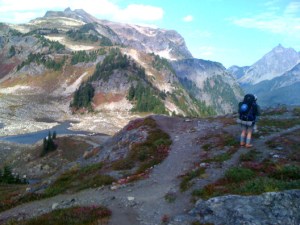
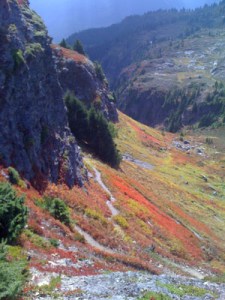
 Searching for Yoldash