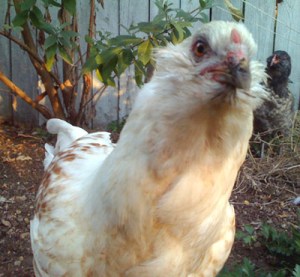
Forrest, meanwhile, still refuses to lay. When Gladys is busy laying an egg, Forrest stares at us through the sliding glass door with bored irritation. She spends most of her time chasing birds and squirrels out of the yard. Yesterday she and Gladys kept two crows at bay for half an hour. The crows would perch on the fence staring at the chickens, knowing something really good must be in a yard so well guarded. But every time they dropped down from the fence, there would be a chicken running at them full speed, head low. So they would retreat back to the fence to wait, staring down at the chickens in the small yard, completely ignoring the two acres of undefended land immediately behind them.
Archive for the ‘Miscellaneous’ Category
Chicks in the City
Posted in Chickens, Miscellaneous, Pacific Northwest, tagged Chickens, eggs, spring on February 19, 2010| 1 Comment »
Goodbye to Salinger
Posted in Miscellaneous, Words, tagged Catcher in the Rye, Salinger, Words on January 28, 2010| 2 Comments »
What is J.D. Salinger to us? Catcher in the Rye was assigned reading in high school, presented by the establishment as a fine example of the antiestablishment. And we devoured it. The kids who hated literature loved Catcher. The kids who loved literature sought out more Salinger (and found very little). Moreover, Catcher as a novel and Salinger as a type of writer became cultural touchstones for generations. We remember the descriptions of Robert Ackley with his pimples and mossy teeth, the mysteriously termed throw that Holden can get for five dollars with a hotel prostitute. Most of all we remember the tone of the novel, at once funny, mean, and sad. But even today, as we are surrounded by entertainment that is arguably funnier and certainly meaner, Catcher still resonates with students. Why?
Hemingway famously stated that all modern American literature comes from Mark Twain’s Huckleberry Finn. In reality, in the latter half of the 20th Century and I think still today, it would be more accurate to say that all modern American writing comes from Hemingway. Short, understated sentences composed of unsentimental, ordinary words. This is how we were taught to write, how we were taught to edit, and what we were taught to value in the writings of others.
It is in this context that we first read Salinger. And while the vulgarities got our attention, I think it is the exposed emotion of the narrator that was really the most shocking. It seemed almost as if the redacted portions of a story had been published by accident, while the approved and conventional parts were left out. When the same English instructor who taught us to write controlled, straightforward prose assigned Catcher in the Rye, the world got a little rounder. We were learning how to write for success, but Salinger reminded us of the voice inside, of the emotions behind the facts. And if we could not get away with writing like that, or of sharing aloud how we really felt about the adults around us, Salinger did it for us. With their permission, it turns out.
The Curious Alien Farm of Medical Lake
Posted in Miscellaneous, Pacific Northwest, tagged alien, Medical Lake, UFO on December 24, 2009| Leave a Comment »
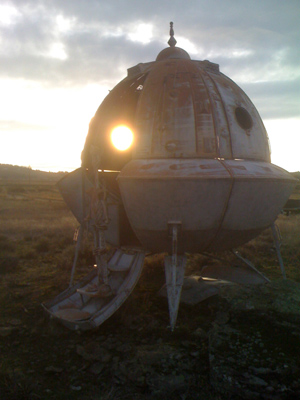
Would aliens, if they were to travel across incredible distances to get here, pass right by our lush coasts, our shining cities, our spectacular mountains, and settle in our most barren landscape? The answer is, Apparently So.
Of course, barren is a relative term. If you’ve grown up anywhere along Washington’s western slopes, where it’s green in the dead of winter but you can still see snow on the peaks through the middle of summer, where horizon is mostly a concept useful for people who live in places without so much Douglas fir in the way, well, then barren is pretty much Medical Lake. Driving east from Seattle, you hold your breath for the 200 miles between Cle Elum and Spokane, waiting for trees to reappear. Halfway through, a Chamber of Commerce radio station declares, with no hint of irony, “There is always plenty of free parking in Ritzville.” And then, right at the end of this long stretch, after hours of dust devils and alfalfa and kids arguing and wheat fields and potatoes and more arguing, right at the transition back into trees and hills and curves in the road, is Medical Lake.
It’s here that two brothers from California—following a stint in Wyoming—purchased 21 acres of land along I-90 about five years ago and began filling half of it with bizarre metal and concrete sculptures, most of them manufactured in Asia. You’ll find flocks of dark menacing eagles, statues of naked men with joking signs over their privates, gargoyles, roosters, even the skulls of Texan longhorns tossed into a bin for sale.
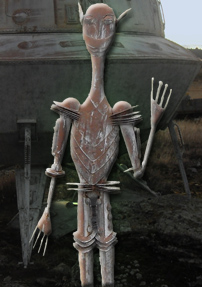
But no one comes here for the skulls. And not many come for the naked men. They come instead to see the UFO and its crop of aliens. The UFO and a seemingly friendly alien are easily visible from I-90. If you take the time to stop by, you’ll find more aliens and even alien-inspired chairs, all on sale.
The aliens and UFO are from China. A life-sized replica of Oscar, the resident dog and security system, is from Thailand. Everything except Oscar is for sale. The owner who met us in November said they had started to get a lot of attention recently from people who found out about the location on the Internet and sneaked onto the property to exchange trinkets. “Geocaching?” I offered. “Yes!” He was irritated by the geocachers because they came onto the property at all hours, without permission, and never purchased a single kitchy statue. We were not purchasing on our visit, either, but at least we were not among the hated geocachers. That is, not until we were halfway to the UFO, when my youngest turned around and shouted back, “We love geocaching! We do it all the time!”
The truth is, our visit had nothing to do with geocaching. Traveling along I-90 in recent years, we had seen the UFO and were beckoned by an alien waving to us from the fenceline. And now, as winter approached, the aliens themselves were on sale for half price at $75. Very hard to resist.
We sat in the UFO, looked around at the myriad sculptures, and talked to the owner about his love of this barren land. This land that grows basalt instead of crops. After years in California and Wyoming, he was home. When I asked what the business, this place, was called, he said simply, “The Farm.” The barren stretch from Cle Elum to Spokane was, to him, the best of all landscapes. And I think that if he were to travel east, he would hold his breath from Couer d’Alene to Missoula, suffocating under the relentless trees and mountains and waiting for the horizon to come back.
Kindling
Posted in Miscellaneous, Words, tagged books, Kindle on November 23, 2009| 3 Comments »
Many people suffer from the misconception that books are just an old fashioned way to share ideas, knowledge, and experience. Books are good for that sort of thing, yes, but before you ditch them for a shiny new Kindle, remember that there are functions printed books perform for us that a Kindle simply cannot duplicate. Consider three of the most important ways a book can be used:
- To Show Off
- To Fend Off
- To Piss Off
A Kindle doesn’t show people how smart you really are.
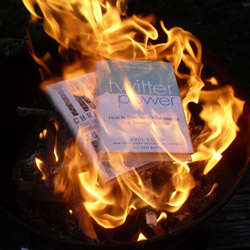
Imagine what it would be like to have offices without bookshelves radiating intelligence and expertise. A lawyer without law books, an editor without a fat orange Chicago Manual of Style, a marketer without something by Seth Godin. How would you know these people were not rank amateurs? I recently worked with a group of marketers who were keenly interested in taking advantage of Twitter, but they couldn’t be bothered to set up Twitter accounts and talk to actual people. So instead, they obtained free copies of Joel Comm’s book Twitter Power and displayed them on their office shelves like diplomas. That way, people visiting their offices saw the book and assumed they were experts in social media. Brilliant!
It’s hard to fend off strangers with your Kindle.
Surely protection is one of the most important, if unappreciated, functions that books perform for us. When you put a book cover between your face and the people around you, you are showing them why it is better not to disturb you. A good friend of mine brought the following book to his daughter’s soccer practices this year: Richard H. Timberlake’s Monetary Policy in the United States: An Intellectual and Institutional History. The title alone told the other parents that he was morose, aloof, and not even remotely interested in discussing the latest scandal about bikini-clad baristas. I used a similar tactic when I rode the Tube every day as a student back in 1989, in this case wielding Daniel Defoe’s A Journal of the Plague Year. This book was doubly effective at keeping strangers away by telling them I was dull and pedantic while reminding them that every breath from every other subway rider could spread disease.
You can’t offend people by destroying your Kindle.
The most grievous of sacrileges in Western Civilization, next to banning books, is burning them. Fahrenheit 451 horrifies us because we equate the burning of books with the annihilation of ideas. If you disagree with an author, nobody cares. But burning a book, now that will get you some attention. The trouble with Kindle is, if the content angers you, you just delete it. If you want to destroy your Kindle, you have to recycle it because it won’t burn. And then instead of offending others, you just look like a good earth-friendly citizen.
Oh yes, and there is one more important way a printed book is superior to any electronic format. Most of us first learned to love books by tearing them apart. I’m talking, of course, about the pop-up book. Long before we learned how to read text, we learned that books sometimes contained pictures that would unfold magically before our eyes when we tugged at the pages. The harder we pulled, the faster the picture jumped up. Until we pulled too hard. And that was when we began to learn about how to be respectful of books and the ideas they contained. You could tug at them a little, fold the corners over if you didn’t have a bookmark handy, maybe write a few notes in the margins. But you were not to tear them, or throw them, or burn them except under extreme circumstances (say, for a blog photo). You might take care of a Kindle because it is expensive to replace, but not because of the ideas it stands for. After all, the Kindle is as much about deleting old ideas as conveying new ones, so in the end the only idea it really stands for is convenience. And no school or library or despotic little country ever found convenience unsettling enough to ban.
That’s why I’m sticking to books where solid ideas are permanently inked onto fragile paper. Books I can use to keep strangers from talking to me. Books I can use to say, “My Dostoyevsky is smarter than your Dan Brown.” And if a funny picture unfolds when I open the pages or pull a secret lever, so much the better.
Seldom With Guides
Posted in Miscellaneous, Pacific Northwest, tagged climbing, Fred Becky, scrambling on November 13, 2009| 1 Comment »
Sometimes while mountaineering in the Pacific Northwest, you’ll fight hours of underbrush, punch through half-frozen rivers, and slip your way up maddening scree under sleet and fog. And just when you are the most lost, the most exhausted, you emerge from the clouds and stumble upon other climbers. They are lost too. They are tired. And they are cursing Becky.
That would be Fred Becky. The man who almost single-handedly defined climbing in the Northwest, who made more first ascents than anyone in recorded history, who will scale a cliff with thousands of feet of exposure more easily than most of us can cross the living room.

When climbers talk about a “Becky Route,” they often mean the hypothetical route which is documented in climbing guides, but seems not to be possible. When they talk about “Becky Time,” they are referring to the mythical Becky pace that will take you from trailhead to summit to bar in one day. You complain about this pace in the late afternoon when you are still trying to reach the summit, and the nearest bar seems continents away.
Like most legends, Fred Becky has his fair share of detractors and acolytes, but he is still a legend. So when we heard he would be speaking at Edgeworks Climbing in Tacoma, we were in.
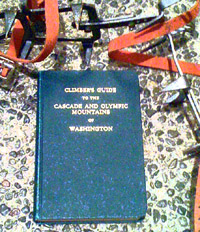
For autographing, I brought along his groundbreaking guidebook from 1949, which the Mountaineers had refused to publish. Long before I was born, my uncle kept notes in this very book as he trained to climb Mount Rainier in 1951-52. By the time I climbed the same peaks, half a century later, avalanches and rockfall had transformed the physical landscape. But the Becky routes remained in print, viable or not.
So I made the pilgrimage to Edgeworks to see Becky’s photographs and hear his wisdom. As it turns out, Becky isn’t so much interested in wisdom. If you invite him to speak at your climbing gym, he’ll tell everyone there to get out of the gym and climb in the “real world.” He will show you peaks from Alaska to Mexico, with photos from climbs in 2008 alongside climbs in 1956. But he will not comment on the out-of-date equipment you see, or the age of the young spry Becky in many of the photos. He is really only interested in the ageless peaks themselves, and the challenge they represent.
After the presentation, I brought him my uncle’s old book to autograph. A book so old it says nailed boots are basic equipment for every climb. But also a book that opens with a statement just as true today as 60 years ago: “Since climbing in Washington is seldom done with guides, self reliance, keen judgment, and the technical competence to climb on steep alpine terrain are prerequisites.”
I presented this old, first edition book from Becky’s youth to him for an autograph. He seemed not to recognize it. And then a 20-year-old behind me pushed forward and said, “You had a John Muir quote at the beginning of your presentation. Can you tell me how Muir inspired you?” And the 86-year-old climbing legend paused and looked tired for the first time in his life. “I never thought about it,” he said.
Meet Forrest
Posted in Chickens, Miscellaneous, tagged Chickens on October 21, 2009| 7 Comments »
Used to be you could identify the nutcases in your neighborhood by their gangly ham radio antenna towers and gardens with too much zucchini. These people lived within a system of ever-evolving technology, efficiency, and comfort. But they weren’t quite comfortable. With every step forward in evolution, they were haunted by a sense that something important was being left behind. They wanted more control of the things they consumed, whether it was food, information, or entertainment. Today you won’t see the ham radio towers in your neighborhood, but there are other signs. Cars with biodiesel bumper stickers. Kids almost floating off in UFO-shaped balloons. Chickens walking casually around the yard as if they were tabby cats.

Forrest
So confession time. We have joined the ranks of crazy suburbanites with chickens.
We have three hens named by my sister who raised them from eggs in Olympia. There is Gladys the Black, Wilbur the Gray, and Forrest the Brown. Forrest was named after a character in a Winston Groom novel who in turn was named after Nathan Bedford Forrest, Confederate general and first Grand Wizard of the Ku Klux Klan, which as most people know is an organization of chickens who run around at night instead of day. Forrest in the novel (and subsequent movie) is a simpleton. Forrest the chicken is a simpleton even by chicken standards. Hence the name.
People today need reassurance about their food. Did my beef come from a happy cow? Did my egg come from a chicken free to walk on actual dirt? Did terrorists sneak into the warehouse during a smoke break to poison my food? When you raise your own chickens, you don’t need to fret over these things because you are in control and know all the details. Today, for example, I know that Wilbur ate nasturtiums, pears, and left-over Cheerios. I know Gladys spent her day under the Japanese maple and the Chevy Suburban hiding from rain. And I know that Forrest followed the other chickens around like a hopeless groupie.
Our hens are only a few months old, so we are still eggless in Seattle. But I can tell you that there is much more to raising chickens than getting fresh eggs every day or an eventual Kung Pao Gladys. We have raised guinea pigs, gerbils, lizards, newts, dogs, cats, two garter snakes, even an orphaned squirrel. Of them all, chickens are the most entertaining to watch. They combine thousands of years of careful domestication with the most primitive of instincts. And when you watch them, you witness both. Chicken life alternates constantly between complacence and panic. Complacence comes from being around familiar company and not having to think.
Chicken panic has three sources:
- Another chicken is getting food that should be mine.
- The neighbor dog/cat/toddler is chasing me.
- The other chickens have left me behind.
Cats are warm on your lap, and snakes are fascinating when they lunge at a banana slug as if it were really capable of escape. But for sheer entertainment, nothing beats a chicken. They do stupid things, which is amusing. They coo when you hold them, which is endearing. And they surprise you with their predictability. For now, I watch them and congratulate myself that one day our eggs will come from a pure, natural source, even if the truth is that our eggs still come from a faraway farm, and our hens are living it up without producing anything to pay the rent.
A Night at the Butcher’s
Posted in Miscellaneous, Pacific Northwest, tagged Bothell, Butcher Shop Cafe, dining, Kenmore, Kirkland, Seattle on October 12, 2009| Leave a Comment »
It’s not every year you dress up and bring your candles to the butcher shop. But this isn’t like most years. Money is tight. Jobs are scarce. The future is more than just a little hazy. In other words, it’s time to get creative. So rather than go to one of Seattle’s great restaurants on our night out, we opted to go directly to the butcher that supplies the best of them. The Butcher Shop Cafe on Juanita Drive is not exactly your ordinary butcher. You can order everything from kielbasa to guinea fowl and have the chef prepare it right there. This Saturday we had prime rib, which was outstanding. For side dishes we pretty much ate everything available, including baked corn salad, beans with brisket, and sauteed squash and peppers. The cafe is more utilitarian than pretty, but for some of us, that is much of the appeal. And what you trade off in elegance you gain in more personal ways. It’s a great place to relax with your best friend, chat with the chef while sampling next week’s menu, and indulge in shamelessly generous portions. And if you happen to wonder where exactly the sirloin cut comes from, why there is a diagram right there behind the counter. It is a working butcher shop, after all. And there are only three tables, so if you plan to go there for dinner, it helps to call ahead. The cafe, butcher, and supplier are all available at 425-485-4658.