Feeds:
Posts
Comments

Archive for the ‘Miscellaneous’ Category

Department of Languishing

I dreamt the other night that I was in the passenger seat while my son was driving slowly into a parked car. No breaks, no deceleration. Just crunching, slow crunching. First we pushed through the bumper, then then trunk, and finally we began to push through the backseat. I wondered when he would stop. My mouth was agape, but the only sound coming out was snoring. This is the nightmare of a parent whose first child has just earned his first driver’s license.

On December 29, after months of practice drives, tedious traffic safety classes, and written tests about school zones and speed limits, our son William joined the millions of adults who have passed through one of American life’s major milestones: A day at the Department of Licensing.

Within fifteen minutes of arriving, he had already taken and passed his driving test. Now the only thing between him and a driver’s license was a handful of DOL employees. But armed with their clever weapons of bureaucracy, they were able to hold an entire room of people at bay for hours. Want to stand in line for a license? First you need to get a number. Want to get a number? First you need to stand in a different line. A line for a number for a line. And although they accept checks, they won’t accept debit cards. I scolded a clerk about this and was kindly shushed by my wife. Scolding, I had hoped, would be an amusing way to pass the time.

The wait turned out to be two-and-a-half hours. Fidgety people sat on hard plastic seats, staring at their smartphones. Staring at the floor. Staring at the number counter that never changed. I went outside for a while and read a journal by a British woman who rode a horse around India in the 1800s while her husband shot at the natives. My wife and I walked next door to the Mexican grocer where they sold candles in tall narrow glasses with pictures of saints and skeletons. They also sold pig’s feet and tripe, gallons of lard, and of course Mexican Coke.  I looked for a candle with the Patron Saint of Tedium. I ended up with a Coke.

William waited next door for his number to be called. And when it finally was called, he went up to the counter, had his photo taken, and walked away with a real Washington State driver’s license.

So now he does not need his parents. He can drive anywhere he wants, whenever he wants. Humptulips or Hackensack. He can choose a college and drive to it. He can drive across the border and disappear. He’s free.

The Department of Licensing is, I think, still too efficient. Someone needs to add a few more layers of bureaucracy. Whatever it takes to slow things down.
Read Full Post »

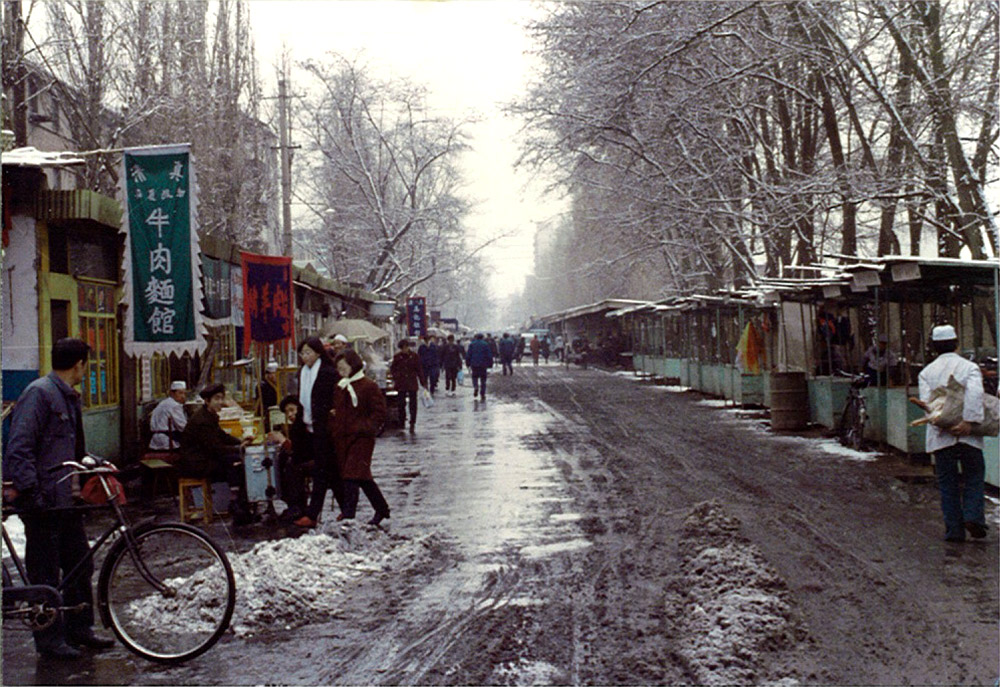
Lanzhou Street Market, 1990

Street market in Lanzhou, China, 1990

Twenty years ago I lived as one of 30 Westerners in a city of 2.5 million Chinese people. That is .0012% of the population. So yes, we stood out. Every afternoon when I walked through the street market, I could hear people calling out, laowai, laowai! (foreigner, foreigner). It wasn’t a matter of being friendly or malicious. It was more like sneezing. They couldn’t help themselves.

Every day for a year, I walked down the same market street and heard the same people call out as I walked by.

  • Monday, shopping for vegetables: Laowai!
  • Tuesday, out to get chow mien: Laowai!
  • Wednesday, walking to Lanzhou University: Laowai!
  • Thursday, walking past the fly-infested butcher stall: Laowai!
  • Friday, in search of garlic: Laowai!
  • Saturday, checking out a giant clay pot: Laowai!
  • Sunday, ready for Uyghur barbecue: Laowai!

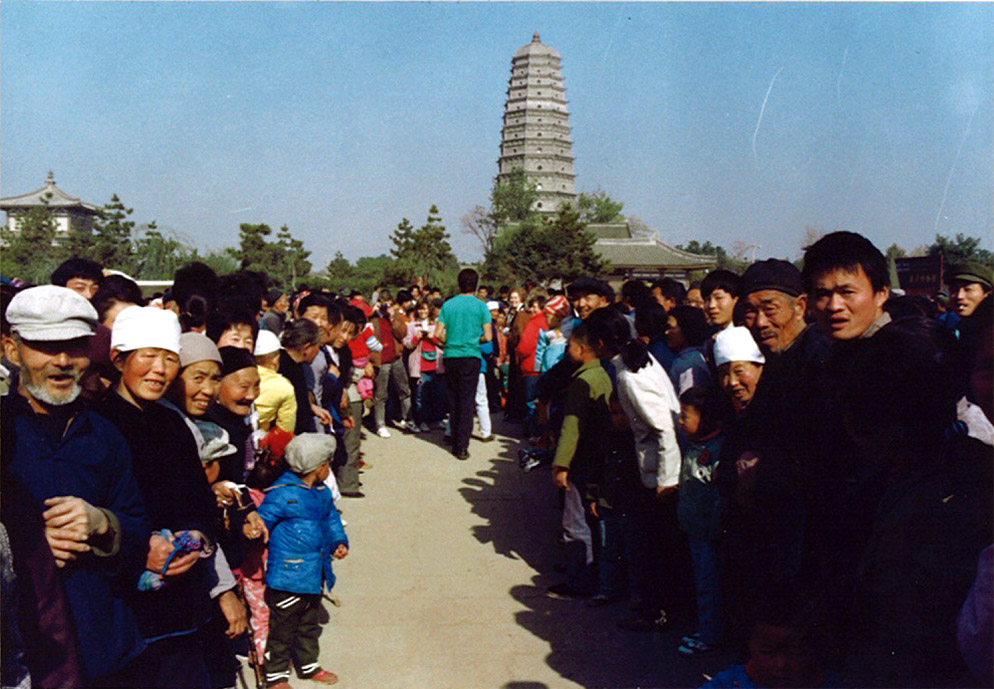
This kind of treatment drives a lot of laowai crazy, but it can also make you feel like a real celebrity. That was the case on a trip the 30 of us took to Famen Temple in neighboring Shaanxi Province. The town of Famen had been closed to foreigners in Communist China until the year we showed up. And we showed up in a big ostentatious tour bus.

Famen crowd

Parting of the crowd outside Famen Temple

Famen holds a relic purported to be the Buddha’s thumb. A little gray-white bone behind glass. On the afternoon we visited, the most magical thing in town was a handful of laowai who could simultaneously draw people together in huge waves and then part them like Moses at the Red Sea.

Twenty years later and back in the States. We are traveling down to Olympia on Thanksgiving in heavy traffic and there is an accident up ahead. Like every other car on the freeway, we creep slowly by looking for damage in the cars pulled off to the side. And then, right in the middle of the accident, we see two little people dressed in their Thanksgiving Day best. I imagine they had been looking forward to dinner with family and friends until an inattentive driver rear-ended their holiday plans and left them stranded. Standing by the side of a busy highway being interrogated by a police officer while countless strangers drive slowly by, staring and muttering instinctively. Laowai.

Read Full Post »

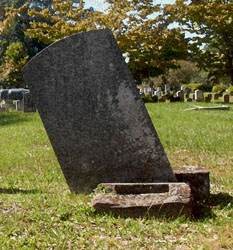
left-leaner at Magnolia Cemetery, Charleston, SCI spent some time last Sunday with the dead at Charleston’s Magnolia Cemetery. Their tombstones leaned left and right, backward and forward. Some had fallen over completely and were broken in half, allowing grass to grow right up through the middle where caretakers dutifully mowed it for the next hundred years. Maybe the caretakers could have taken the time to set these markers straight again, but people come to Magnolia because of the way things tilt and crack and crumble.

The cemetery with its revolutionaries and Civil War veterans and myriad personal stories is a natural tourist destination, even if the caretakers don’t seem to know quite what to do with tourists. Arrows direct visitors down lanes marked No Trespassing. And there other restrictions not found in your typical graveyard. No Swimming. No Fishing.

But most people don’t come to the cemetery to swim with their ancestors. They come for the atmosphere and the history. There is a Confederate soldier who survived being wounded in battle only to succumb to typhoid. There are three separate crews of the C.S.S. Hunley–the submarine that only went down. And there are countless stories of the individuals who came to South Carolina from every part of the world and shaped it into what we know today.

It is easy, for a moment, to begin to feel that you are back in their world. But if you visit on a humid autumn day after a week of rain, there are also plenty of small striped mosquitoes that are only too willing to remind you that you are still flesh and blood.

Read Full Post »

We received notice on our front door two weeks ago that there was a water leak on our property, and we had 30 days to get it fixed. Or else. The blue wheel on the water meter spun when it should have been stationary. Water oozed up through the driveway and rolled down the street. Money liquified.

So on Friday, we rented a 905-pound Barreto trench digger and bought 100 feet of new waterline. We tore through big rocks and small rocks and sand and soil. Three of us held the half-ton machine back as it tried to roll downhill into the neighbor’s yard. And sometime during the first two hours of digging, my son reached deep into the ground in front of the rumbling trencher and pulled out a beautiful, docile skink.

The skink is just like a bright green chameleon, except that is dull brown and it reacts to the changes around it by staying exactly the same color. It does have a somewhat famous defensive tactic of throwing off its tail and growing a new, blue tail. But this skink did not have time to drop its tail. The trencher yanked it up into our world, or the skink fell into the new trench in a panicked run. In any case, we had the skink for a good five minutes, docile and confused. And then we released it back into the terrifying, quaking world.

Something like ten days after we received our notice, we had the new trench dug and the new waterline hooked up. So our money is no longer rolling down the street. And as I write this post, the skink is out there somewhere above our new waterline. Hiding from the cats.

Here is what I learned:

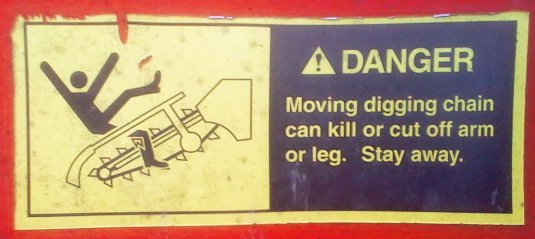
  • The walk-behind trencher is like a Grecian monster, half John Deere tractor and half chainsaw. You can use it to dig a trench to Australia if you have enough time.
  • All the how-to videos for walk-behind trenchers on YouTube have been made by people who were renting one for the first time. These people have no idea of how to use a trencher, and they should not be filming themselves.
  • The skink has a name which sounds extremely unflattering. Perhaps if it learned to change colors, things would be different.

Trencher Warning

Read Full Post »

William gets a leaner for two points

Two circles of orange lantern light on a backwoods road in Montana, with some 30 feet of utter darkness in between. We stand at one end helping to light a dull gray stake slanting up from the dirt and grass. Our partners take aim.

An arm goes swinging back once and then forward in a smooth arc, releasing a spinning red horseshoe. It might land next to the stake for a point, or even grab it for a ringer. Or it might just clock me in the shin. For an uncomfortable moment the horseshoe is hurtling invisibly toward us, trajectory unknown. By the time it emerges into our circle of light, it is too late to dodge out of the way. And that was the easy one. The next horseshoe is black.

Someone grumbles about the rules which we are not following. The stars wheel overhead past a narrow opening framed in tamarack and pine. And I am thinking about the grizzly watching us from a black forest; a giant who left her scat farther down this same road the day before. And there are cougars watching us because they are curious as well as hungry. And I am thinking about how this game must be even more difficult in the Shetland Islands, where it’s so terribly foggy and they have to make the best of it with those really tiny shoes.

Read Full Post »

View from Pisgah

View from Pisgah

It might be true that I climbed Mount Pisgah in part because the name made me giggle, but Pisgah is not funny. Pisgah is a serious hill in the Blue Ridge Mountains of  North Carolina that gets to be called a mountain because it is taller than everything else around it. The hike up Pisgah is very nice. You pass a lot of people in flip flops who would look out of place on a real mountain. And if you hike past them with a backpack as I did, they will stare at you as if you were some sort of strange nerd. Because hiking Pisgah with outdoor equipment is like taking a tent and survival gear to the cinema in case a storm blows in while you are watching Harry Potter and the Chamber Pot of Pisgah. Or something like that.

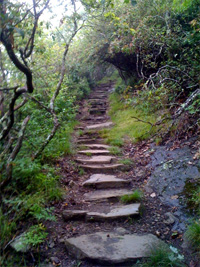
Path to Pisgah

Path to Pisgah

The Mount Pisgah in North Carolina is named after the biblical mountain from which Moses first saw the Promised Land. In both places one should have an expansive view over promising territory. Moses in his excitement might even have marked this territory as his, but the Old Testament is silent on that Pisgah’s etymology.

When I climbed Mount Pisgah, I passed flip floppers who scoffed at me. I passed cigarette smokers who coughed at me. And at last I reached the summit where I could look around and see an impenetrable fog in all directions. I thought of all the times I had climbed for hours and hours in the towering Cascades, daring avalanches and crossing dangerous terrain just to have this exact same view. White cloudy foreverness. Moses doubted and struggled, but at last he saw the Promised Land stretched out before him. Whereas when I was on Pisgah, people just peered into the fog and said, “Wait, is that Greenville down there?”

Read Full Post »

For my first trip to the Ozarks, I made sure to pack the essentials for hiking in 106 degree weather: mosquito repellant, sun tan lotion, and a book about the Siberian Arctic. If you can’t keep cool, you can at least submerse yourself in freezing literature.

What I did not bring was a map because St. Louis has its own REI, so I could pick a map up on my way from the airport. Trouble is, the REI in St. Louis doesn’t actually sell maps of the Missouri backwoods. It sells running clothes and dog toys and bags of smoked salmon from Anacortes, Washington. I settled for the salmon and moved on to the Whole Foods next door where I found Washington wine and Bing cherries–also from Washington. If I got lost, I would have comfort food.

My freezing book, In the Land of White Death, had everything you could ask for in a true-life tale of survival. A bunch of guys slogging for months across unstable pack ice, drowning and starving and hallucinating about hot places like the Ozarks in July. On the plane ride from Seattle to St. Louis, after years of looking at this book on my shelf at home, I finally had a chance to read it.

The drive down to Mount Bell was interesting. Once in the Ozarks, I found quintessential backcountry things to photograph, like a drive-through window for cigarettes with an enticing “Cheap Smokes” sign; a tremendously oversized American flag completely enveloping its undersized staff like some sort of Christo exhibition; and a John Deere baseball cap on the side of the road with rolling hills in the distance. I took these pictures so I could remember my trip to the Ozarks. And at the Mark Twain National Forest Potosi Ranger Station, I even found a brochure with enough topographic lines to serve as a map. I was ready to join the rest of the backpackers heading to the state’s best summit.

Except that in July, no one climbs Mount Bell. Something about the 106 degree heat, humidity, and biting bugs keeps people away. So I had the mountain to myself, which was just fine with me.

Because of the heat, I waited until late afternoon to leave the trailhead, arriving at the summit shortly before sunset. This is not your narrow, jagged Cascade summit. On the top of Mount Bell, you can wander through the low forest and over broad reddish boulders to get a view in almost any direction. I found a good campsite on the edge of a cliff looking east. Set out my gear. Wandered about the summit. Enjoyed my salmon and cherries and wine as the sun dropped into a bank of western clouds. And I spent some time with my book, In the Land of White Death.

It was 1912. There was a ship of unlucky Russians stranded ice-bound above 71 degrees north, waiting to die. But a few brave souls dared to walk across hundreds of miles of shifting slabs of frozen ocean, dragging heavy tents and makeshift kayaks behind them in an attempt to reach the Franz Josef Archipelago before another winter set in. After weeks of near starvation they began to find game to hunt. The author reveled:

Seal brains fried in seal oil also taste very good. The front flippers, well baked, are reminiscent of calves’ feet.

For some reason, this passage struck me as particularly beautiful. I set the book down and searched through my things to find a pencil. Ever since my first reading of Moby Dick more than twenty years ago, I have kept an index of beautiful phrases and their corresponding page numbers in the back of every book I read. In this case, I decided to simply write “Eating Seals 49.” 

So you can imagine my surprise and horror when I discovered a penciled note already inside the back cover that read: Eating Seals 49.

There was only one logical conclusion. I had already read this book. I had been struck by the exact same passage, and left the exact same note in the back. Yet I had no memory of reading the book. It was as if my future self had come to visit in a time machine and left graffiti on my wall. Not funny.

And then the sun was gone from the Ozarks. From darkness the moon came out to illuminate the canopy of treetops below me, and the canopy itself seemed to float above the black world below it. And across this dim canopy a thousand fireflies began to flash like lightning in an upside-down storm. Or was it more like synapses misfiring in the ever-darkening brain? I looked out across this spectacular flashing world with an idle camera in one hand, knowing that the camera could not capture its beauty. And I wondered if I would remember this moment in the hot and humid Ozarks, and this feeling. Or if I would one day look back at my photographs and remember only a drive-through window for cigarettes, and a flag so heavy it had never known how to fly in the wind.

Read Full Post »

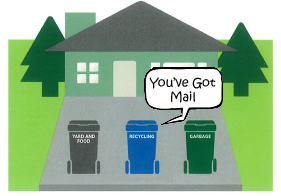
New Mailbox

Sometimes the benefits of being annexed by a neighboring city are not immediately clear. When the City of Kirkland closed our park at Juanita Beach and forgot to reopen it, for example, I failed to appreciate it. I was also puzzled when our garbage and recycling bins were taken away last week. But this week the bins were replaced with new ones, and they came with a surprise.

Taped up under one of the lids was a note that looked a lot like junk mail. It turned out to be important tax information with the following explanation:

Dear Finn Hill, North Juanita, and Kingsgate Resident,
You recently received a City Service Guide in the mail that we hope you find to be a helpful and useful resource. Unfortunately, the 2011 Property Tax Comparison on page 23 is incorrect; please replace it with the correct version shown below.

In other words, “We sent you inaccurate tax information by mail, so to make things right we are delivering the corrections to you in a garbage can.”

Makes sense to me.

Read Full Post »

Cyclist BustedSomeone across the street from our office used to hang a fat-lettered sign inside their 5th-story office window that read: WARNING: SPEED TRAP. The sign alerted drivers at the intersection of NE 8th and 112th Avenue NE in Bellevue that they were being watched. But it isn’t exactly a speed trap. The intersection is complicated mess, with drivers entering from more 19 lanes of traffic including a 3-lane offramp, plus inconspicuous no-right-on-red signs and an onramp to top it all off. With every green light and so many drivers trying to navigate through the maze of lanes and restrictions, someone is bound to break a law. And most mornings a Bellevue motorcycle patrolman is there to catch them.

Up on the 8th floor of my office, across from the warning sign, I am used to the brief blip blip of the siren that tells me someone is being pulled over. I wheel my chair over to look down with curiosity at the misfortune of others, or Schadenfreude if you are German. The Bellevue police can  be more disruptive to workplace productivity than Spider Solitaire.

But occasionally, the routine is broken. One overcast day last week things did not go as planned for the Bellevue police. There was no blip blip for an interminable 10 to 15 minutes of green lights. The silence got my attention. I looked down and saw a motorcycle officer spying from his hideout. Ponch and John had been reduced to John with paunch. No driver was willing to commit an infraction. He looked bored. So at last, he drove his motorcycle through the crosswalk and nabbed a middle-aged woman waiting for the light to turn green. She was on a bicycle.

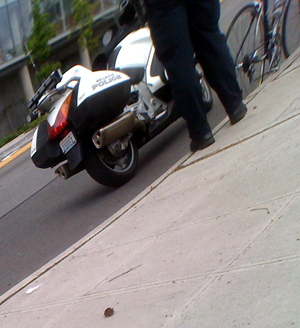
As a cyclist who often deserves to be cited, this really caught my attention. How could you get a ticket for just waiting at a red light? I ran down the stairs, camera phone in hand. I snapped a bad photo of the legs of the officer as I walked by. And then, when it was all over, I found an excuse to talk to both the cyclist and the officer.

She seemed a little bewildered and swore she had not done anything wrong. But for a trained officer, the offense was obvious: The cyclist waiting for a light to turn green was “splitting lanes.” At this particular intersection, that means that she was waiting on the far right of the through lanes and allowed a car to pull up alongside her. She thought she was being polite by not getting in the way of cars waiting to go through the intersection. But she should have been impolite. By allowing a car to pull up next to her in the same lane, she had violated a law designed to keep motorcycles from driving between cars on the freeway.

The last part of my snooping was to find out how much the cyclist had been fined for letting a car pull up next to her. Fortunately for me, the Washington State Patrol has an active and helpful Twitter account. And the answer is: $124. Sometimes it is best not to share the road.

Splitting Lanes

Read Full Post »

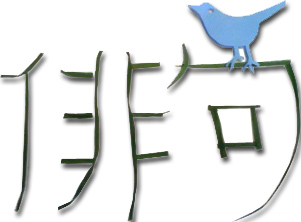
Twitter HaikuThe first haiku I will not share with you in haiku form. It was constructed strictly to win a contest, and I’m not talking about a beauty contest here. At stake were ten new  BlackBerry PlayBooks, to be awarded to the ten best haikus published on Twitter about the new device.

The contest was beautifully simple: Tweet an original haiku about the new BlackBerry PlayBook while complying with the following restrictions:

Rule 1:
The poem must consist of three lines of 5, 7, and 5 syllables respectively.

Rule 2:
The poem must not mention competing products (Read: Don’t mention the iPad).

But most of the entries went something like this:
          Please for God’s sake give me
          A PlayBook  cuz I wanna win really bad!
          Down with iPad!

This created somewhat of an unfair advantage for winning contestants like Lisa Akari who knew how to follow rules, knew how to construct elegant haiku, and were familiar with Basho. Her approach was to honor the form while having fun. Sadly, there is also a low road to victory.

My approach was to create the kernal of a hypothetical marketing campaign. To be honest, I’m a little in love with my concept, but my execution through haiku was ungainly, like the debut of a beautiful model in ill-fitting clothes. So in this blog post I’m pulling it out of haiku and presenting the concept alone.

I wanted to convey a sense of universe-at-your-fingertips awe about this new tablet computer. I wanted to capture the feeling you would get if you could have this power with you wherever you went, from an evening at home to an afternoon at the neighborhood coffeeshop to a rained-out vacation on the Oregon Coast. All accessible through a tablet computer. I came up with this:

Haiku 1 Tagline Concept
Columbus was wrong. The world is flat.

I do think this is much more interesting than the official PlayBook tagline: “The world’s first professional-grade tablet,” which violates Rule 2 in spirit even if it does not name the iPad explicitely, and has readers reaching for their Chicago Manual of Style: Is that a compound adjective and do I need a hyphen?

So yes, I prefer my approach and I want to see it used in a new marketing campaign. That would be the greatest prize of all. But getting a brand new PlayBook is a decent consolation prize and I’m eager to get that into my hands as well. When you enter a contest on Twitter, there is always a little bit of doubt: What if the contest is a scam? What if the Twitter @blackberry account is run by some pimply teenager in Medicine Hat (the Gas City), Alberta?

I have to admit I started to worry after getting the initial “You’ve Won” announcements and then not hearing much more. So I sent the following haiku to fellow winner Lisa Akari as we were both waiting for updates:

Tagline Haiku 2
     Blackberry haiku
     Sweet promise, like morning mist
     Evaporating

But then I checked my email. There was a notification about my winning entry and a new form to fill out. This time they asked for my social security number as well as a written signature. So at last I will receive my new PlayBook as a genuine winner of the haiku contest. Or I will provide my social security number and signature to some scam artist in Alberta.

It is hard, sometimes, to separate the hope we have for tomorrow from the coarse reality of the moment. As  Matsuo Basho recorded in The Narrow Road to the Deep North:

     Bitten by fleas and lice,
     I slept in a bed,
     A horse urinating all the time
     Close to my pillow.

Read Full Post »

« Newer Posts - Older Posts »