If you come around a bend in the trail to find Ranger Magenta waiting for you, and the ptarmigans have already turned white, and the wind keeps blowing you off your feet, pay close attention. Winter has come.
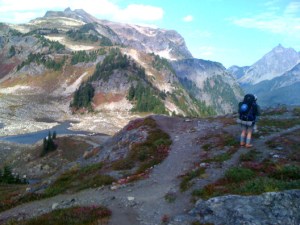
Above Yellow Aster Lakes
This is what I learned Monday and Tuesday on our trip to Tomyhoi Peak in the North Cascades. We started out smearing sunscreen on our faces, heading up into one of the best places to see fall colors in the Pacific Northwest. It was sunny and we hoped for a clear ascent to the summit. But first the wind kicked up, and then I saw that the ptarmigans had already put on their stark white plummage, which seemed out of place in the bright oranges and dark purples of autumn. And then we ran into the park ranger.
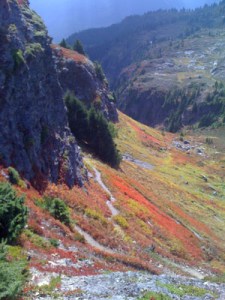
Autumn colors along trail to Tomyhoi
Magenta is a strong woman. She left the trailhead while we were still assembling our packs, made it to the Yellow Aster Lakes to warn hikers and campers of the oncoming storm, summited Yellow Aster Butte for her own interest, and got back down to the main trail in time to intercept us. “Did you get the weather report?” she asked. We said Yes, and after an awkward pause offered, “But you can remind us.” The forecast was for snow dropping to 4400 feet with an incoming storm, and the winds were already topping 45 mph. The park ranger’s name was really Magenta. Her lips were stained dark purple from huckleberries. She had turned around two hikers before we got there, but we had crampons and ice axes and rope and had already lied about knowing the weather report, so she knew we were too foolish to be reasoned with.
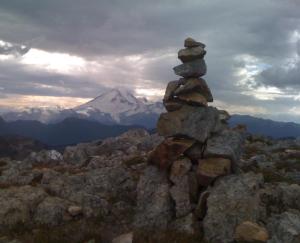
Cairn and Mount Baker
The wind got worse, but the snow held off for a while and the scenery was spectacular. At 5000 feet the huckleberries were so abundant we could grab them without slowing down.
We could still see Baker and Shuksan and Ruth and the Chilliwacks across the border in Canada. By 6000 feet the huckleberry and heather had been reduced to a dense 1-inch carpet.
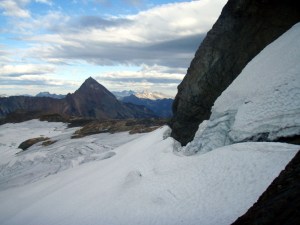
Tomyhoi Glacier with Mount Larrabee in the distance
Within an hour there was nothing but wind and rock and glacier.
Tomyhoi Glacier in late September has crevasses and a few snow bridges, but it’s easy enough to navigate. We started to run out of daylight less than 500 feet below the summmit, and with the storm coming and the exposure of the final ascent too risky to do in ice, we retreated. Next year, we figured.
Back across the glacier, we stopped at the first water we came to. My old Peak 1 Coleman stove burned furiously, but to little effect. By the time we had dinner, the snow had started to accumulate, and then the storm really hit. It would
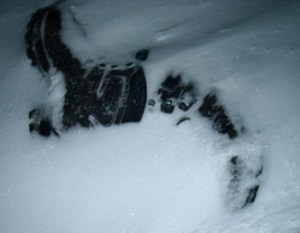
Finding my boots in the morning
have been a nice time to have an actual tent. I cinched up my bivy so there was only a two-inch hole for air, but enough snow came through that to keep me awake most of the night. Ptarmigans taunted us in the dark with their calls. By morning we had drifts over us and the pond was frozen. But the snow and the wind had stopped and it was a beautiful day.
The trail back to the Yellow Aster Lakes was obscurred by snowdrifts, and there was not a soul left in the valley. The only footprint I saw between Tomyhoi Peak and the trailhead was from a small black bear. At the trailhead we met three women who were heading up to see autumn. They were a day late.
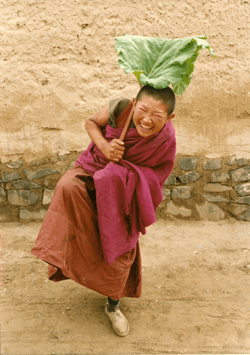 Back in 1990 when I worked in Lanzhou, China, I traveled to a small Tibetan village with a few friends. On the way up our bus started to break down. The driver opened the engine compartment and fixed things right up with a pencil. Ridiculous and ingenious. That is China, everywhere you go.
  Searching for Yoldash